
Direct answer
Working as a plasterboard fitter in Amsterdam is feasible for foreign workers, with EU/EEA and Swiss nationals able to work without permits, while non-EU nationals must secure Dutch work and residence permits before starting. The job involves installing drywall panels in residential, commercial, and renovation projects. Amsterdam offers salaries often higher than in many other European cities, though living costs, especially housing, are relatively high and may lead many workers to commute from nearby towns. Safety certification such as VCA is commonly required, and basic Dutch or English language skills improve communication and safety on site. Contracts are typically temporary or project-based, with a standard 40-hour workweek.
Key points
- EU/EEA/Swiss nationals can work in Amsterdam without a permit; non-EU workers need valid work and residence permits.
- Plasterboard fitters install drywall panels for walls and ceilings in new builds, renovations, and commercial interiors.
- VCA safety certification is often mandatory or preferred on Amsterdam construction sites.
- Salaries depend on experience, role, CAO/collective agreements, and region; Dutch construction pay is often higher than in many other European countries.
- High housing costs in Amsterdam lead many workers to live in surrounding towns and commute daily.
- Typical contracts are temporary or project-based, with a 40-hour workweek standard.
- Basic Dutch or English language skills are important for safety and teamwork.
- Common projects include apartment buildings, office refurbishments, and historic building renovations.
- Essential tools include tape measures, utility knives, drills, plasterboard lifters, and joint finishing tools.
- Personal protective equipment (PPE) such as helmets, gloves, dust masks, and safety glasses is mandatory.
- Commuting options include public transport, cycling, and car travel from towns like Almere, Haarlem, and Zaandam.
- Haldu Groep has placed plasterboard fitters in Amsterdam since 1999, with expertise in local labor market conditions and housing arrangements.
Field expertise
Since 1999, Haldu Groep has specialized in placing skilled construction workers, including plasterboard fitters, in the Netherlands. Their experience highlights the importance of compliance with Dutch labor laws, possession of safety certifications like VCA, and effective communication skills in Dutch or English. Amsterdam’s construction market is dynamic, with ongoing new builds and renovations requiring adaptable tradespeople. Temporary and project-based contracts are common, reflecting the sector’s cyclical nature. Haldu Groep’s knowledge supports foreign workers in navigating legal requirements and integrating smoothly into Amsterdam’s construction workforce. Housing arrangements depend on the placement and agency, but with Haldu Groep, housing is typically well arranged, often including a private bedroom for the worker.
What should you know about plasterboard fitter jobs in amsterdam: guide for foreign workers?
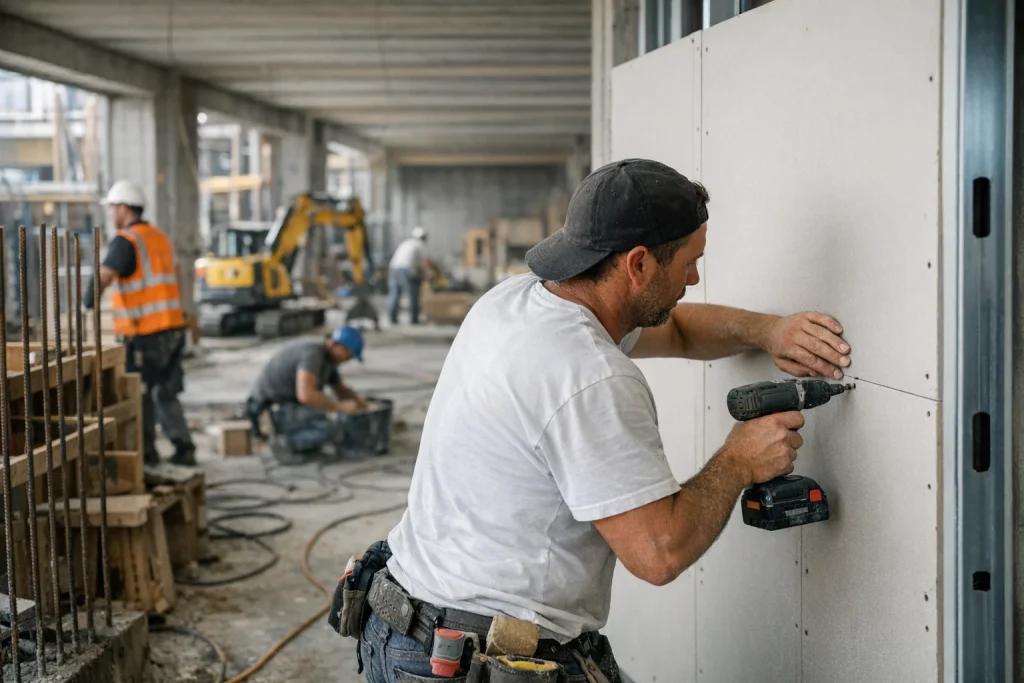
Plasterboard fitters in Amsterdam install drywall panels to form interior walls and ceilings. The role demands physical strength, precision, and knowledge of construction materials and techniques. EU/EEA and Swiss nationals can work without permits, but non-EU workers must secure Dutch work and residence permits. VCA certification is often required to meet strict safety standards. Projects range from renovating historic buildings to fitting out offices and constructing new apartment complexes. Due to Amsterdam’s high housing costs, many fitters commute from nearby towns such as Almere, Haarlem, or Zaandam. Basic Dutch or English skills improve safety and communication on site.
How does plasterboard fitter jobs in amsterdam: guide for foreign workers work in practice?
A typical workday begins with measuring walls and ceilings, cutting plasterboard sheets to size, and fixing them to metal or wooden frames using drills and screws. Fitters then apply joint tape and compound to smooth seams. Wearing PPE such as helmets, gloves, and dust masks is mandatory. Communication in Dutch or English helps coordinate with other trades and follow safety instructions. Contracts are usually temporary or project-based, with a 40-hour workweek. Employers often require VCA certification and proof of legal work status. Many fitters commute by bike, public transport, or car from surrounding towns due to limited housing availability in Amsterdam.
Which conditions apply for plasterboard fitter jobs in amsterdam: guide for foreign workers?
Foreign plasterboard fitters must comply with Dutch labor laws and construction safety regulations. EU/EEA/Swiss nationals have unrestricted work rights, while non-EU workers need valid work and residence permits. Employment contracts typically follow the CAO Bouw & Infra, which sets minimum wages, working hours, and conditions. VCA certification is often required to meet safety standards. Workers must use PPE and adhere to site safety rules. Basic Dutch or English language skills are recommended to ensure clear communication and compliance with safety protocols.
Which mistakes are common around plasterboard fitter jobs in amsterdam: guide for foreign workers?
Common errors include starting work without proper permits (especially for non-EU workers), lacking VCA certification, and underestimating the importance of language skills. Some workers fail to prepare for Amsterdam’s high living costs and housing scarcity, leading to financial strain or long commutes. Misunderstanding Dutch labor agreements (CAOs) can cause confusion about wages and working hours. Neglecting safety rules or PPE use risks accidents and job loss. Relying on informal job offers instead of registered agencies or employers can result in unstable or illegal work situations.
How do you proceed step by step?
- Verify your eligibility to work in the Netherlands (EU/EEA/Swiss vs non-EU).
- If non-EU, apply for a Dutch work and residence permit before arrival.
- Obtain or renew VCA safety certification if required.
- Prepare a clear CV highlighting plasterboard fitting experience and certifications.
- Learn basic Dutch or English phrases related to construction and safety.
- Search for jobs via agencies like Haldu Groep or direct employers in Amsterdam.
- Understand the CAO Bouw & Infra terms for wages, hours, and contracts.
- Arrange housing or plan commuting routes from nearby towns; with Haldu Groep, housing is typically well arranged, often including a private bedroom.
- Start work with proper PPE and follow site safety procedures.
- Consider additional training or language courses for career advancement.
What should you check before you start?
- Confirm your legal right to work in the Netherlands and have necessary permits.
- Verify that your VCA certification is valid and recognized by employers.
- Understand your employment contract, including salary, hours, and duration.
- Ensure you have or can access required personal protective equipment (PPE).
- Check language requirements and prepare accordingly for communication.
- Research the job site location and housing or commuting options; housing arrangements vary by placement and agency.
- Know the main safety rules and emergency procedures on the construction site.
- Clarify payment terms and payroll details with your employer or agency.
What does this look like in practice?
A plasterboard fitter typically arrives early at the Amsterdam construction site, wearing safety gear and reviewing the day’s tasks with the team. They measure walls, cut plasterboard sheets with utility knives, and attach them to metal studs using drills and screws. After installation, they apply joint compound and tape to seams for a smooth finish. Communication with other trades ensures coordination. Work usually lasts 8 hours with breaks, under contracts lasting weeks or months. Many fitters live outside Amsterdam and commute by train, bike, or car, balancing job demands with the city’s high living costs.
| Aspect | Amsterdam | Other Dutch Cities (Rotterdam, Eindhoven) |
|---|---|---|
| Average gross salary (monthly) | Depends on experience / CAO / contract | Depends on experience / CAO / contract |
| Typical working hours | 40 hours/week | 40 hours/week |
| Housing cost (1-bedroom rent) | Relatively high; many workers commute from nearby towns | Moderate; varies by city and location |
| Common commuting distance | Often 10–30 km from surrounding towns | Often 5–20 km |
| VCA certification requirement | Often mandatory | Often mandatory |
| Work Permit Requirement | EU/EEA/Swiss Workers | Non-EU Workers |
|---|---|---|
| Need for Work Permit | No | Yes |
| Residence Permit | No | Yes |
| Application Process | Not required | Apply via Dutch Immigration (IND) |
| Employer Role | Not required | Employer must sponsor permit |
| Essential Tools for Plasterboard Fitters | Purpose |
|---|---|
| Tape Measure | Accurate measurement of walls and boards |
| Utility Knife | Cutting plasterboard sheets |
| Drill and Screwdriver | Fixing boards to frames |
| Plasterboard Lifter | Handling large boards safely |
| Joint Taping Tools | Applying joint compound and tape |
| Personal Protective Equipment (PPE) | Reason |
|---|---|
| Safety Helmet | Protect head from falling objects |
| Work Gloves | Protect hands from cuts and abrasions |
| Dust Mask | Prevent inhalation of dust particles |
| Safety Glasses | Protect eyes from debris |
| Ear Protection | Reduce noise exposure on site |
Frequently asked questions
Do EU/EEA and Swiss workers need a work permit to work as plasterboard fitters in Amsterdam?
What work permits do non-EU plasterboard fitters need?
Is VCA certification mandatory for plasterboard fitters in Amsterdam?
What is the average salary for plasterboard fitters in Amsterdam?
How does the cost of living in Amsterdam affect plasterboard fitters?
What language skills are needed for plasterboard fitters?
What are typical working hours and contract types?
What safety equipment must plasterboard fitters use?
What types of projects employ plasterboard fitters in Amsterdam?
How can foreign workers find plasterboard fitter jobs in Amsterdam?
Conclusion
Foreign workers aiming for plasterboard fitter jobs in Amsterdam should first confirm their legal work status and secure necessary permits and certifications like VCA. Understanding Dutch labor agreements and preparing for the city’s high living costs is essential. Basic Dutch or English skills improve safety and teamwork on site. Many workers commute from nearby towns due to housing shortages. Using trusted recruitment agencies and preparing a clear CV can ease the job search. With proper preparation, plasterboard fitting in Amsterdam offers competitive pay and steady opportunities in a vibrant construction market. Housing arrangements depend on the placement and agency; with Haldu Groep, housing is typically well arranged, often including a private bedroom for the worker.
