
Direct answer
Carpenter jobs in Tilburg are accessible to foreign workers, with EU/EEA/Swiss citizens allowed to work without a permit, while non-EU nationals must secure a valid Dutch work permit before starting. Tilburg’s active construction sector offers diverse carpentry roles in residential, commercial, and infrastructure projects. Pay depends on factors such as experience, contract type, collective labor agreements (CAOs), and region; it is advisable to confirm details in the written offer. Basic Dutch or English language skills are essential for safety and effective communication on site. Employers or agencies often arrange housing, which typically includes a private bedroom in shared apartments. Safety certifications like VCA are commonly required, and personal protective equipment (PPE) is mandatory. Tilburg’s compact size and good public transport make commuting practical for foreign carpenters working in the city.
Key points
- EU/EEA/Swiss citizens can work without a permit; non-EU workers need a valid work permit.
- Carpentry roles include framing, roofing, interior finishing, and formwork.
- Pay depends on experience, CAO Bouw & Infra agreements, contract type, and employer; Dutch construction pay is often higher than in many other European countries but varies by role and location.
- Basic Dutch or English language skills improve safety and teamwork.
- Housing is often arranged by employers or agencies like Haldu Groep, usually with private bedrooms.
- VCA safety certification is often mandatory or strongly recommended.
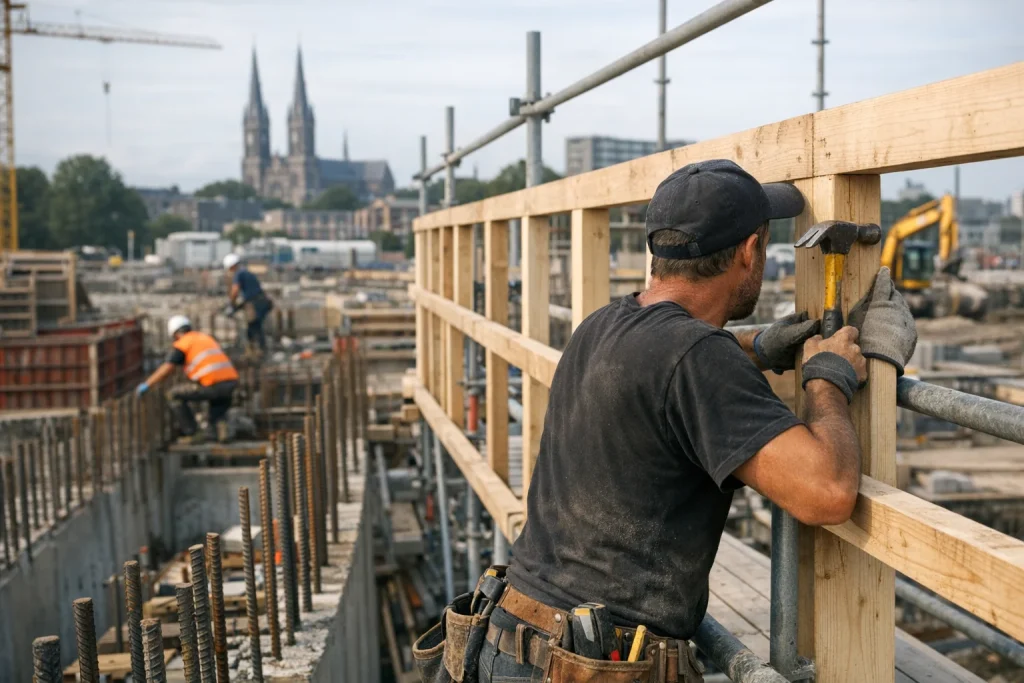
- Standard tools include saws, hammers, chisels; PPE includes helmets, gloves, boots.
- Tilburg’s public transport and bike paths facilitate easy commuting.
- Vocational training and on-the-job learning support career development.
- Understanding Dutch labor law and CAOs helps protect worker rights.
- Common challenges include language barriers and adapting to local work culture.
- Preparing a Dutch-style CV increases chances with employers.
Field expertise
Since 1999, Haldu Groep has specialized in placing foreign workers in Dutch construction roles, including carpentry jobs in Tilburg. The company understands Dutch labor laws, CAO Bouw & Infra agreements, and safety standards such as VCA certification. Tilburg’s construction market is active, with ongoing projects in housing, commercial buildings, and infrastructure requiring skilled carpenters. Agencies like Haldu Groep assist with housing arrangements, transport advice, and language support, helping foreign carpenters integrate into the local labor market. Safety and fair pay are emphasized, aligned with Dutch regulations and collective agreements.
What should you know about carpenter jobs in Tilburg: guide for foreign workers?
Carpenter jobs in Tilburg involve tasks such as wood framing, roof construction, interior finishing, and scaffolding. Tilburg’s construction sector includes new residential developments, commercial renovations, and public infrastructure projects. EU/EEA/Swiss workers can start immediately without a permit; non-EU workers must obtain a work permit before employment. Basic Dutch or English language skills are important for safety and communication on site. Employers often require VCA certification, which demonstrates knowledge of safety protocols. Housing is usually arranged by the employer or agency and often includes shared apartments with private bedrooms. Understanding Dutch labor laws and CAOs helps workers know their rights and benefits.
How does carpenter jobs in Tilburg: guide for foreign workers work in practice?
Foreign carpenters in Tilburg typically apply through recruitment agencies or directly to construction companies. After confirming work permit status (if needed), candidates submit a CV tailored to Dutch standards. Upon hiring, carpenters receive job-specific training and safety briefings, including VCA certification if not already held. Employers or agencies often arrange housing near the worksite or city center. Daily work involves using standard carpentry tools and wearing personal protective equipment (PPE) such as helmets, gloves, and safety boots. Communication on site is usually in Dutch or English, with strict adherence to safety and quality protocols. Transport options include public transit, bicycles, or employer-provided shuttles.
Which conditions apply for carpenter jobs in Tilburg: guide for foreign workers?
Conditions for carpenters in Tilburg include compliance with Dutch labor law and the CAO Bouw & Infra collective agreement. Pay scales vary based on experience, role (apprentice, experienced carpenter, team lead), and contract type (temporary or permanent). Working hours generally follow standard Dutch schedules, with possible overtime during busy periods. Safety regulations require VCA certification or equivalent, and employers provide necessary PPE. Language skills are expected to ensure safe and efficient work. Housing conditions vary but are generally comfortable and close to job sites when arranged by agencies like Haldu Groep. Non-EU workers must have a valid work permit and register with Dutch authorities.
Which mistakes are common around carpenter jobs in Tilburg: guide for foreign workers?
Common mistakes include:
- Starting work without the correct work permit if non-EU.
- Underestimating the importance of basic Dutch or English for safety and teamwork.
- Failing to obtain or renew VCA certification before starting on site.
- Not preparing a CV that meets Dutch employer expectations.
- Ignoring housing arrangements and arriving without accommodation plans.
- Overlooking CAO rules and labor rights, causing misunderstandings about pay and hours.
- Not bringing or using appropriate personal protective equipment.
- Neglecting local transport options, resulting in difficult commutes.
How do you proceed step by step?
- Check your nationality: EU/EEA/Swiss citizens do not need a work permit; non-EU workers must apply for one.
- Prepare a clear CV highlighting carpentry skills, certifications, and experience.
- Apply through trusted agencies or directly to Tilburg construction employers.
- Obtain or renew VCA certification and other relevant safety training.
- Arrange housing through your employer, agency, or independently, ideally before arrival.
- Register with Dutch authorities if staying long-term (non-EU workers).
- Attend job orientation and safety briefings on site.
- Use provided tools and personal protective equipment; follow site safety rules.
- Communicate clearly with supervisors and colleagues, using Dutch or English.
- Understand your contract, pay scale, and working hours under the CAO.
What should you check before you start?
Before starting a carpenter job in Tilburg, verify:
- Your legal right to work in the Netherlands (work permit if non-EU).
- That your CV and certifications (VCA, First Aid) are current.
- Housing arrangements and location relative to the job site.
- Details of your employment contract, including pay, hours, and benefits.
- Language requirements and whether you need additional training.
- Availability of personal protective equipment and tools.
- Transport options for commuting to work.
- Contact information for your employer or agency for support.
What does this look like in practice?
In practice, a foreign carpenter arriving in Tilburg will typically:
- Receive a job offer and sign a contract aligned with CAO Bouw & Infra standards.
- Attend a safety induction, including VCA training if necessary.
- Move into employer-arranged housing, often a shared apartment with private bedrooms.
- Commute daily by bike or public transport, common in Tilburg’s compact urban area.
- Work on various projects such as residential homes, office buildings, or infrastructure like bridges.
- Use standard carpentry tools and wear PPE like helmets, gloves, and boots.
- Communicate with supervisors in Dutch or English to coordinate tasks and ensure safety.
- Receive pay according to experience and CAO agreements; exact amounts vary by role and contract.
- Have opportunities for further training or career advancement through vocational courses.
| Aspect | EU/EEA/Swiss Citizens | Non-EU Citizens |
|---|---|---|
| Work Permit | Not required | Required before starting work |
| Housing | Often employer/agency arranged, typically with private bedrooms | Often employer/agency arranged, typically with private bedrooms |
| Language | Basic Dutch or English recommended | Basic Dutch or English recommended |
| Safety Certification (VCA) | Often required | Often required |
| Pay | Depends on experience, CAO, and contract | Depends on experience, CAO, and contract |
| Carpentry Role | Typical Tasks | Experience Level | Pay Range |
|---|---|---|---|
| Apprentice Carpenter | Basic wood cutting, measuring, assisting | Entry level | Depends on experience / CAO |
| Experienced Carpenter | Wood framing, roof construction, finishing | Several years | Depends on experience / CAO |
| Team Lead Carpenter | Supervision, complex joinery, site coordination | Advanced | Depends on experience / CAO |
| Housing Type | Typical Features | Availability | Cost Considerations |
|---|---|---|---|
| Shared Apartment | Private bedroom, shared kitchen/bathroom | Common via agencies | Varies by location and arrangement |
| Private Room | Single room in shared housing | Often arranged by employer/agency | Varies by location and arrangement |
| Independent Rental | Entire apartment or house | Available but requires personal arrangement | Varies; usually higher and requires deposit and contract |
Frequently asked questions
Do EU citizens need a work permit to work as carpenters in Tilburg?
How can non-EU carpenters obtain a work permit for Tilburg?
What types of carpentry projects are common in Tilburg?
What is the typical pay range for carpenters in Tilburg?
Are there specific collective labor agreements for carpenters?
What language skills do carpenters need in Tilburg?
Is VCA certification required for carpenters in Tilburg?
What tools and protective equipment do carpenters use?
How is housing arranged for foreign carpenters in Tilburg?
What are common challenges for foreign carpenters in Tilburg?
Conclusion
Foreign carpenters aiming to work in Tilburg should first confirm their work permit status and prepare a Dutch-style CV highlighting relevant skills and certifications. Obtaining VCA certification and arranging housing before arrival will ease the transition. Basic Dutch or English skills improve safety and communication on site. Understanding the CAO Bouw & Infra agreement ensures fair pay and working conditions. Tilburg’s construction market offers diverse opportunities across residential, commercial, and infrastructure projects. Planning ahead for legal, housing, and language requirements supports a smooth start and successful career in Tilburg’s building trades. For further guidance, consult Haldupedia’s resources on construction jobs, VCA certification, and housing for foreign workers in the Netherlands.
