
Direct answer
Working as a bricklayer in Groningen is accessible for foreign workers. EU/EEA and Swiss nationals can work without a permit, while non-EU citizens must obtain a valid Dutch work permit before starting. Pay depends on experience, contract type, and collective labor agreements (CAO), often offering competitive wages compared to many European countries. VCA safety certification is commonly required. Basic Dutch language skills improve communication and safety but are not always mandatory initially. Housing arrangements depend on the employer or agency; with Haldu Groep, housing is typically well organized and includes private bedrooms. Groningen’s construction sector features diverse projects, and commuting is convenient by bike, public transport, or car.
Key points
- EU/EEA/Swiss citizens can work in Groningen without a permit; non-EU workers need a valid Dutch work permit.
- Pay depends on experience, CAO agreements, contract type, and employer; Dutch construction wages are competitive.
- VCA safety certification is often required or strongly recommended for bricklayers.
- Basic Dutch language skills improve job prospects and safety but are not always mandatory initially.
- Common projects include residential, commercial, infrastructure, and restoration works in Groningen.
- Working hours follow Dutch labor laws; contracts may be temporary or permanent.
- Housing is often arranged by employers or agencies; Haldu Groep typically provides private bedrooms.
- Groningen is bike-friendly with good public transport, facilitating easy commuting.
- Recognition of foreign qualifications may require validation or bridging courses.
- Career progression includes specialization, site supervision, or further vocational training.
- Understanding Dutch workplace culture and safety norms is important for integration.
Field expertise
Since 1999, Haldu Groep has specialized in placing foreign workers in Dutch construction roles, including bricklayers in Groningen. The company supports workers with legal compliance, housing, and safety certification such as VCA. Dutch construction labor law and collective labor agreements (CAOs) regulate pay and working conditions, ensuring fair treatment. The Groningen construction market is diverse, with ongoing residential expansions, commercial developments, and infrastructure projects requiring skilled bricklayers. Employers value practical skills, safety awareness, and adaptability to Dutch work culture. Language skills and recognized qualifications improve job security and career growth.
What should you know about bricklayer jobs in Groningen: guide for foreign workers?
Foreign bricklayers should understand the legal framework for working in Groningen. EU/EEA and Swiss nationals enjoy free labor market access, while non-EU workers must secure a Dutch work permit before employment. Pay is influenced by experience, contract type, and CAO agreements, which set minimum wages and working conditions. VCA safety certification is often mandatory to meet Dutch safety standards on construction sites. Basic Dutch language skills help with communication and safety but are not always required at the start. Housing may be provided or arranged by employers or agencies, often including private rooms. Groningen’s construction sector offers a variety of projects, from new residential buildings to infrastructure and restoration, providing diverse opportunities for bricklayers.
How does bricklayer jobs in Groningen: guide for foreign workers work in practice?
In practice, foreign bricklayers typically apply through recruitment agencies or directly to employers. After confirming legal eligibility, candidates may need to validate foreign qualifications or complete bridging courses to meet Dutch standards. VCA safety certification is usually required before starting work. Employers provide contracts aligned with CAO Bouw & Infra or other applicable agreements. Housing arrangements vary; agencies like Haldu Groep often offer well-organized accommodation with private bedrooms. Groningen’s compact city layout encourages commuting by bike or public transport. Work involves traditional and modern masonry techniques on diverse projects, requiring adherence to safety protocols and teamwork.
Which conditions apply for bricklayer jobs in Groningen: guide for foreign workers?
Conditions include legal eligibility to work, pay according to CAO agreements, safety certification, and contract terms. EU/EEA/Swiss workers do not need permits; non-EU workers require a valid Dutch work permit. Pay depends on experience, role, and contract type. VCA certification is often mandatory for safety compliance. Contracts may be fixed-term or permanent, with standard Dutch working hours and labor rights. Housing may be provided or supported by the employer or agency. Dutch language skills improve safety and integration but are not always compulsory at the start.
Which mistakes are common around bricklayer jobs in Groningen: guide for foreign workers?
Common mistakes include starting work without the correct permit (for non-EU workers), underestimating the importance of VCA certification, and not verifying contract terms or pay details. Some foreign workers neglect to validate their qualifications, limiting job opportunities. Poor Dutch language skills may cause safety risks or misunderstandings on site. Housing arrangements are sometimes overlooked, leading to last-minute difficulties. Not understanding CAO agreements or labor rights can result in unfair treatment. Ignoring cultural workplace norms can hinder integration and teamwork.
How do you proceed step by step?
- Check your legal eligibility to work in the Netherlands (EU/EEA/Swiss vs non-EU).
- Prepare a clear CV highlighting bricklaying experience and qualifications.
- Apply for relevant jobs via recruitment agencies or direct employers in Groningen.
- Obtain or validate necessary certifications, including VCA safety training.
- Secure a work permit if you are a non-EU worker.
- Review and sign your employment contract, confirming pay and working conditions.
- Arrange or confirm housing, possibly through your employer or agency.
- Prepare for commuting and familiarize yourself with Groningen’s transport options.
- Start work, follow safety protocols, and improve Dutch language skills on the job.
- Explore career development opportunities and further training.
What should you check before you start?
- Confirm your legal right to work and, if needed, that your work permit is valid.
- Ensure your employment contract clearly states pay, hours, and job role.
- Verify if VCA certification or other safety training is required and completed.
- Check housing arrangements and living conditions if provided by the employer.
- Understand your rights under the relevant CAO (e.g., CAO Bouw & Infra).
- Assess your Dutch language skills and plan for improvement if needed.
- Confirm the tools and personal protective equipment (PPE) you need to bring or receive.
- Learn about the specific construction projects and employer expectations.
What does this look like in practice?
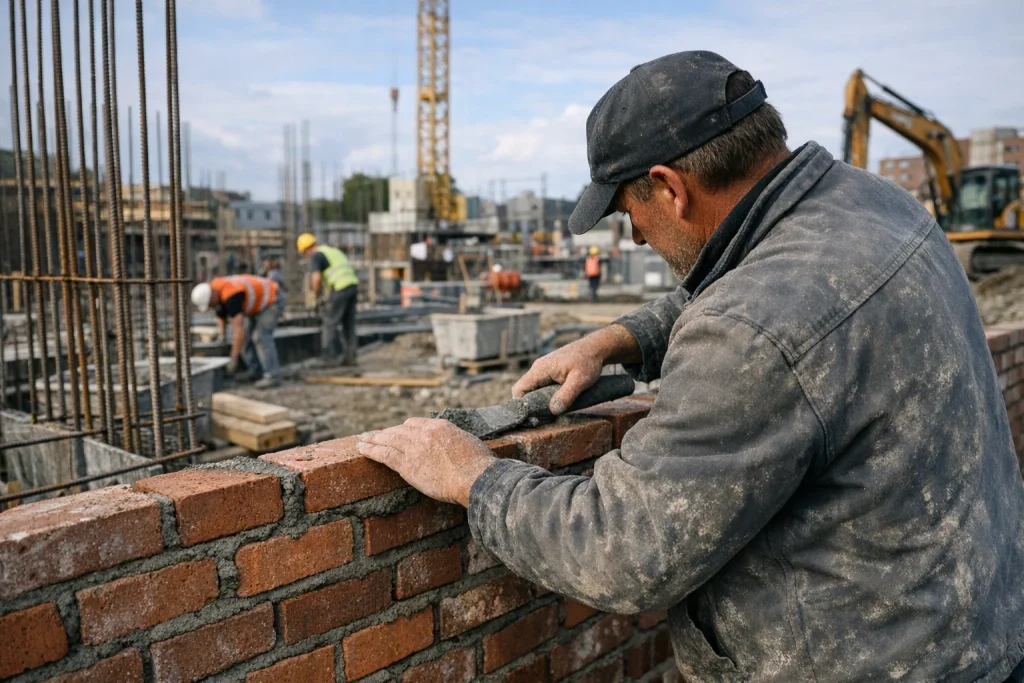
A foreign bricklayer arriving in Groningen typically registers with a recruitment agency or employer. After submitting a CV and proof of qualifications, the candidate may attend an interview and complete VCA safety training. Once hired, the worker signs a contract aligned with Dutch labor laws and CAO agreements. Housing is often arranged by the agency or employer, with private bedrooms common. Daily work involves bricklaying tasks such as laying clay bricks or concrete blocks, mixing mortar, and following bonding patterns. Communication on site may be in simple Dutch or English, with colleagues supporting integration. Commuting is usually by bike or public transport, reflecting Groningen’s compact city design.
| Aspect | EU/EEA/Swiss Workers | Non-EU Workers |
|---|---|---|
| Work Permit | Not required | Required before starting work |
| VCA Certification | Usually required or recommended | Usually required or recommended |
| Housing | Often arranged by employer or agency | Often arranged by employer or agency |
| Language Requirement | Basic Dutch recommended | Basic Dutch recommended |
| Contract Types | Temporary or permanent | Temporary or permanent |
| Pay Factor | Impact on Wage | Notes |
|---|---|---|
| Experience Level | Depends on experience and CAO | Entry-level to senior bricklayers |
| CAO Agreement | Sets minimum pay and conditions | CAO Bouw & Infra applies to most |
| Contract Type | Permanent contracts often offer better pay | Temporary contracts common for newcomers |
| Employer Size | Larger firms may offer higher pay | Small firms may have flexible terms |
| Common Construction Projects in Groningen | Description |
|---|---|
| Residential Housing | New apartment blocks, single-family homes, renovations |
| Commercial Buildings | Office buildings, retail spaces, warehouses |
| Infrastructure | Roadworks, bridges, public facilities |
| Restoration Projects | Historic buildings and monuments |
Frequently asked questions
Do I need a work permit to work as a bricklayer in Groningen?
What certifications are required for bricklayers in Groningen?
How much do bricklayers earn in Groningen?
Is Dutch language proficiency necessary?
What types of projects will I work on as a bricklayer in Groningen?
How are working hours and contracts structured?
Is housing provided for foreign bricklayers?
How do I validate my foreign bricklaying qualifications?
What tools and safety equipment do I need?
How do I commute to construction sites in Groningen?
Conclusion
Foreign bricklayers can find rewarding jobs in Groningen by understanding legal requirements, securing necessary certifications like VCA, and preparing for local working conditions. EU/EEA/Swiss workers benefit from permit-free access, while non-EU workers must obtain work permits. Pay is competitive, housing is often arranged by employers or agencies, and Groningen’s compact city supports easy commuting. Improving Dutch language skills and validating qualifications enhance job prospects and safety. Following CAO agreements ensures fair pay and conditions. Start by applying through trusted agencies or employers, confirm your contract details, and prepare for a successful career in Groningen’s construction sector.
