Direct answer
Concrete carpenter jobs in Tilburg are accessible to foreign workers, with EU/EEA/Swiss citizens able to work without a permit, while non-EU nationals must secure a valid Dutch work permit before starting. These jobs involve building formwork and installing reinforcement bars for concrete structures on various construction projects. Pay depends on experience, role, and collective labor agreements (CAO), generally offering competitive wages in the Dutch construction sector. Housing is often arranged by agencies like Haldu Groep, typically providing private bedrooms in shared accommodations. Basic Dutch or English language skills and a VCA safety certificate are important for site safety and communication. Tilburg’s active construction market and good transport connections make it a practical location for concrete carpenters commuting from nearby towns.
Key points
- EU/EEA/Swiss citizens can work in Tilburg without a work permit; non-EU workers need a valid permit.
- Concrete carpenters build formwork and install reinforcement bars for concrete structures.
- Pay varies by experience, CAO agreements, and contract type; generally competitive in the Dutch market.
- Housing is often provided or arranged by agencies, usually with private bedrooms and shared facilities.
- VCA safety certification is commonly required or strongly recommended on construction sites.
- Basic Dutch or English language skills improve safety communication and job prospects.
- Tilburg’s construction sector includes residential, commercial, and infrastructure projects.
- Good public transport and road networks support commuting from surrounding towns.
- Training and apprenticeships are available for career development in concrete carpentry.
- Typical working hours are day shifts, with occasional overtime or weekend work depending on project needs.
- Haldu Groep has placed foreign concrete carpenters in Tilburg since 1999, supporting permits and housing.
- Understanding Dutch labor laws and CAO agreements is essential for fair treatment and pay.
Field expertise
Since 1999, Haldu Groep has specialized in placing skilled workers, including concrete carpenters, within the Dutch construction sector. Concrete carpenters in Tilburg focus on assembling formwork, fixing reinforcement bars, and assisting with concrete pouring for various building types. The Dutch construction industry enforces strict safety regulations, requiring workers to hold VCA certificates and use personal protective equipment (PPE) such as helmets, gloves, and safety boots. Collective labor agreements (CAO Bouw & Infra) regulate pay, working hours, and conditions, ensuring fair treatment. Tilburg’s construction market is active, with projects ranging from housing developments to infrastructure upgrades, supported by good transport links and local amenities for foreign workers.
What should you know about concrete carpenter jobs in Tilburg: guide for foreign workers?
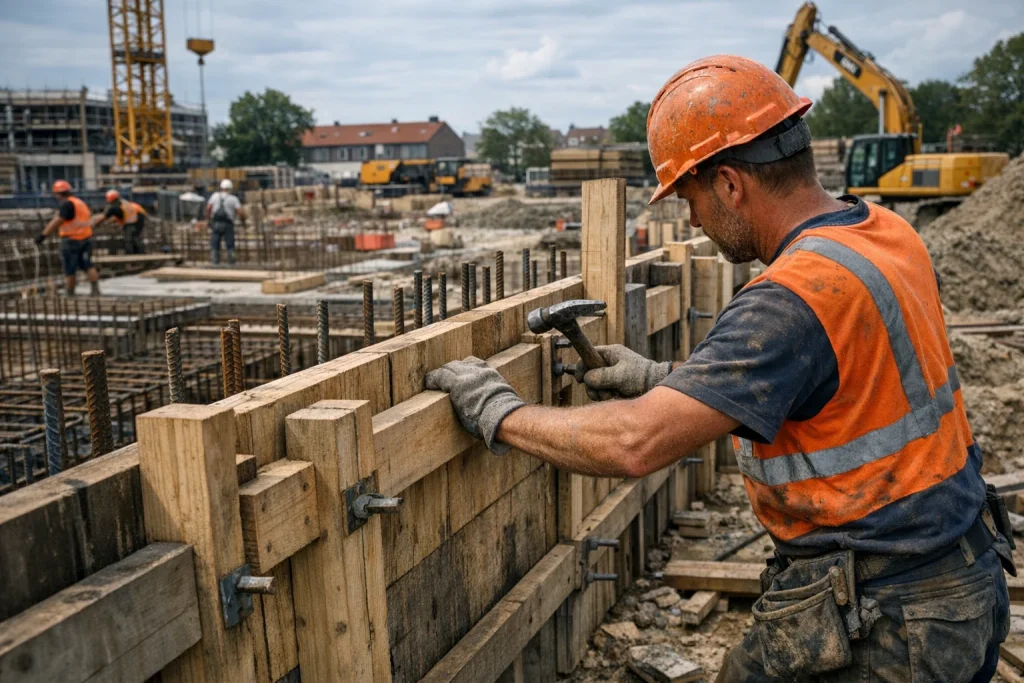
Concrete carpenters in Tilburg build temporary molds (formwork) from wood or metal to shape concrete structures and install steel reinforcement bars (rebar) to strengthen the concrete. The role requires precision, physical strength, and knowledge of safety standards. Foreign workers must understand Dutch labor laws, safety requirements, and local work culture. EU/EEA/Swiss citizens benefit from freedom of movement, while non-EU workers need a valid work permit issued by the Dutch Immigration and Naturalisation Service (IND). Basic Dutch or English language skills help with communication and safety on site. Housing options vary, but agencies often assist with accommodation. Familiarity with CAO agreements and VCA certification improves job prospects and compliance.
How does concrete carpenter jobs in Tilburg: guide for foreign workers work in practice?
In practice, concrete carpenters in Tilburg arrive at construction sites to measure, cut, and assemble formwork using timber, plywood, and steel. They secure reinforcement bars according to engineering plans before concrete is poured. After casting, they may assist with finishing and curing processes. Work schedules typically involve early starts and day shifts, with occasional overtime. Workers use tools such as hammers, measuring tapes, concrete vibrators, and power saws. Personal protective equipment (PPE) is mandatory. Foreign workers often find jobs through agencies like Haldu Groep, which also help arrange housing and provide guidance on permits and safety training. Communication on site is mostly in Dutch or English.
Which conditions apply for concrete carpenter jobs in Tilburg: guide for foreign workers?
Concrete carpenters in Tilburg must comply with Dutch labor laws and safety regulations. EU/EEA/Swiss citizens do not need work permits, but non-EU workers require a valid permit before employment. Employers and agencies ensure compliance with the CAO Bouw & Infra, covering wages, working hours, holidays, and social benefits. VCA safety certification is often mandatory to work on Dutch construction sites. Workers must wear PPE and follow site safety rules. Language skills in Dutch or English are essential for understanding instructions and safety briefings. Housing conditions depend on the employer or agency; many provide well-maintained shared housing with private bedrooms.
Which mistakes are common around concrete carpenter jobs in Tilburg: guide for foreign workers?
- Starting work without a valid work permit for non-EU citizens, risking legal issues and fines.
- Underestimating the importance of VCA safety certification, which is often required on site.
- Not having basic Dutch or English language skills, leading to communication problems and safety risks.
- Failing to check the terms of the CAO or contract, resulting in misunderstandings about pay and working hours.
- Ignoring the need for proper personal protective equipment, compromising safety.
- Assuming housing will always be provided without confirming arrangements with the agency or employer.
- Not preparing for the physical demands and technical skills required for formwork and reinforcement tasks.
- Neglecting to register with local authorities or understand local living costs and transport options.
How do you proceed step by step?
- Check your eligibility to work in the Netherlands: EU/EEA/Swiss citizens do not need a permit; non-EU workers must apply for one.
- Obtain necessary qualifications, including VCA safety certification and relevant carpentry training.
- Prepare a clear CV highlighting your experience in concrete carpentry and related skills.
- Contact recruitment agencies like Haldu Groep or search online job platforms specializing in Dutch construction jobs.
- Confirm housing arrangements if offered by the agency or employer; otherwise, plan accommodation independently.
- Learn basic Dutch or English phrases relevant to construction site communication.
- Understand the CAO Bouw & Infra terms that apply to your job, including pay scales and working hours.
- Attend safety briefings and wear appropriate PPE on site.
- Plan your commute using Tilburg’s public transport or local road networks.
- Keep your documents, permits, and certificates updated and accessible.
What should you check before you start?
- Verify your legal right to work in the Netherlands and have the correct work permit if needed.
- Confirm your employment contract details, including pay, working hours, and job description.
- Ensure you have a valid VCA safety certificate or arrange to obtain one before starting.
- Check the housing conditions if accommodation is provided; clarify costs, privacy, and facilities.
- Understand the tools and PPE you must bring or will be supplied on site.
- Learn about the specific construction project and your role within the team.
- Know the location of the worksite and plan your travel or commuting options.
- Prepare your CV and any references or proof of experience requested by the employer.
- Review the CAO Bouw & Infra provisions relevant to your job.
- Confirm language requirements and consider taking a basic Dutch or English course if needed.
What does this look like in practice?
A foreign concrete carpenter arriving in Tilburg typically starts by meeting with the agency or employer to finalize paperwork and discuss housing. They attend a safety induction, including VCA training if not already certified. On site, they work alongside Dutch and international colleagues, assembling formwork and installing reinforcement bars according to technical drawings. Communication is mostly in Dutch or English, with supervisors providing instructions and safety updates. Workdays start early, often around 7 am, and last 8 hours with breaks. PPE such as helmets, gloves, and safety boots are worn at all times. Housing is usually in shared apartments or houses arranged by the agency, offering private bedrooms and basic amenities. Commuting from nearby towns is common, supported by Tilburg’s good public transport system.
| Aspect | EU/EEA/Swiss Citizens | Non-EU Citizens |
|---|---|---|
| Work Permit | Not required | Required before starting work |
| VCA Certification | Often required or recommended | Often required or recommended |
| Housing | Agency arranged or self-arranged, often with private bedrooms | Agency arranged or self-arranged, often with private bedrooms |
| Language Skills | Basic Dutch or English recommended | Basic Dutch or English recommended |
| Pay | Depends on experience, role, and CAO agreements | Depends on experience, role, and CAO agreements |
| Common Tools | Personal Protective Equipment (PPE) |
|---|---|
| Hammer | Safety helmet |
| Measuring tape | Work gloves |
| Concrete vibrator | Safety boots |
| Power saw | High-visibility clothing |
| Training/Certification | Purpose | Typical Duration |
|---|---|---|
| VCA Basic | Safety awareness for construction workers | 1 day |
| VCA VOL | Safety for supervisors and managers | 2 days |
| Vocational Carpentry Training | Technical skills for carpentry and formwork | 1-3 years (apprenticeship) |
Frequently asked questions
What are the main duties of a concrete carpenter in Tilburg?
What qualifications are required to work as a concrete carpenter in Tilburg?
Can EU/EEA/Swiss citizens work as concrete carpenters in Tilburg without a permit?
What are the work permit requirements for non-EU concrete carpenters in Tilburg?
How does the pay for concrete carpenters in Tilburg compare to other Dutch cities?
What types of construction projects are common for concrete carpenters in Tilburg?
Is housing provided for foreign concrete carpenters working in Tilburg?
What language skills are needed to work as a concrete carpenter in Tilburg?
How important is a VCA safety certificate for concrete carpenters in Tilburg?
What are typical working hours and shift patterns for concrete carpenters in Tilburg?
Conclusion
Foreign workers interested in concrete carpenter jobs in Tilburg should confirm their work permit status, obtain VCA certification, and prepare a clear CV emphasizing relevant experience. Agencies like Haldu Groep provide valuable support with job placement and housing. Basic Dutch or English language skills enhance safety and communication on site. Understanding the CAO Bouw & Infra ensures fair pay and working conditions. Tilburg’s active construction sector and good transport links make it a practical choice for concrete carpenters from across Europe. Planning ahead for permits, housing, and training will help ensure a smooth start to working life in Tilburg.