
Direct answer
Concrete carpenter jobs in Rotterdam are accessible to foreign workers, with EU/EEA/Swiss citizens able to work without permits, while non-EU nationals require a valid Dutch work permit before employment. These jobs demand vocational training in concrete carpentry and mandatory VCA safety certification. Pay is competitive and depends on experience, contract type, and collective labor agreements (CAO). Housing is often arranged by employers or agencies, usually offering private bedrooms near construction sites. Basic Dutch or English language skills are essential for safety and teamwork. Rotterdam’s busy port, infrastructure projects, and urban development ensure steady demand for skilled concrete carpenters throughout the year.
Key points
- EU/EEA/Swiss citizens can work in Rotterdam without a permit; non-EU workers need employer-sponsored permits.
- Concrete carpentry requires vocational training and VCA safety certification for site access.
- Pay depends on experience, contract type, and CAO agreements; generally higher than many European countries.
- Rotterdam’s construction focuses on port infrastructure, urban housing, and commercial developments.
- Housing is often arranged by agencies or employers, typically with private bedrooms and shared facilities.
- Basic Dutch or English language skills are recommended for safety and communication.
- Working hours usually follow Dutch labor laws and CAO Bouw & Infra standards.
- Personal protective equipment (PPE) such as helmets, boots, and gloves is mandatory on site.
- Rotterdam’s excellent public transport and bike infrastructure support commuting.
- Haldu Groep has placed foreign concrete carpenters in Rotterdam since 1999, assisting with jobs and housing.
- Non-EU workers must register with Dutch tax authorities and social security after arrival.
- Weather and seasonal factors can affect concrete pouring and finishing schedules.
Field expertise
Haldu Groep, established in 1999, specializes in placing skilled construction workers, including concrete carpenters, in Rotterdam and the surrounding region. Concrete carpentry involves assembling formwork (bekisting), installing reinforcement bars (wapening), and assisting with concrete pouring and finishing on projects such as port expansions, bridges, and residential buildings. Success in this role requires knowledge of Dutch labor laws, CAO agreements, and safety protocols like VCA certification. Haldu Groep collaborates with local employers to ensure foreign workers meet these standards and helps arrange suitable housing near job sites, easing the transition for international workers.
What should you know about concrete carpenter jobs in Rotterdam: guide for foreign workers?
Concrete carpentry in Rotterdam demands specialized skills in building formwork and placing steel reinforcement for concrete structures. Foreign workers must understand the legal framework: EU/EEA/Swiss citizens can work freely, while non-EU nationals need a valid work permit and employer sponsorship. Vocational training such as MBO Bouwkunde or concrete carpentry courses is essential, along with VCA safety certification. Rotterdam’s construction market is diverse, with projects ranging from port infrastructure to urban housing developments. Basic Dutch or English language skills improve communication and safety on site, which is critical in this physically demanding and safety-sensitive role. The city’s large port and ongoing urban renewal projects ensure steady demand for concrete carpenters.
How does concrete carpenter jobs in Rotterdam: guide for foreign workers work in practice?
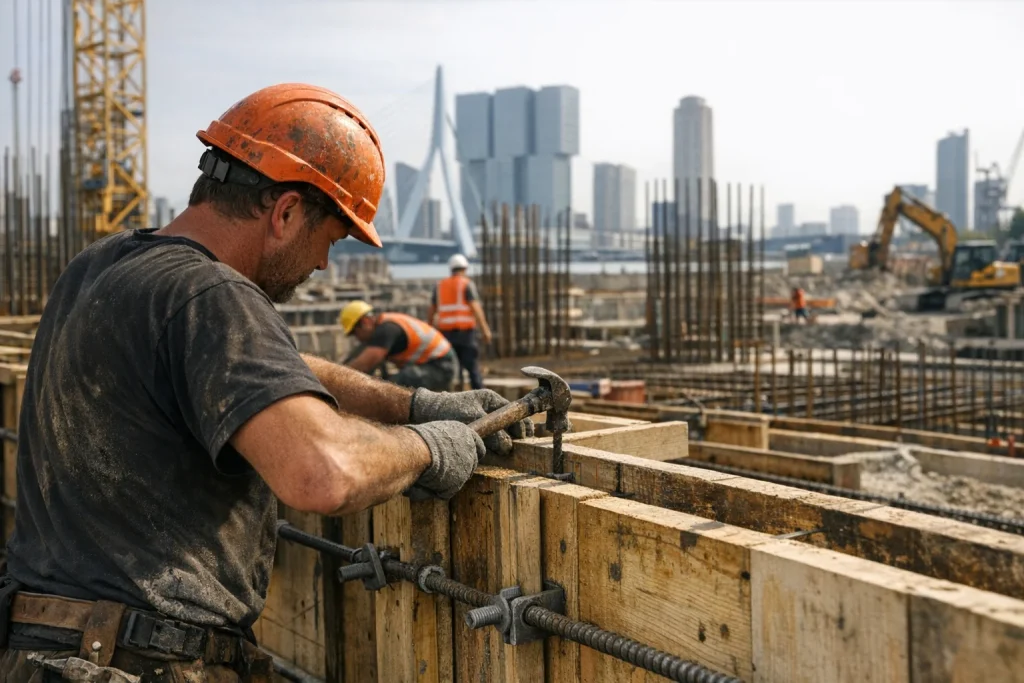
Foreign concrete carpenters usually apply through recruitment agencies or directly to construction companies. Employers verify qualifications and safety certifications before hiring. Upon starting, workers attend safety briefings and receive site-specific training. Daily tasks include assembling timber or steel formwork, tying reinforcement bars, and assisting with concrete pouring and finishing. PPE is mandatory, and workers must follow Dutch labor laws and CAO agreements for fair pay and working conditions. Housing is often arranged by the employer or agency, usually close to the worksite. Commuting is commonly done by bike or public transport, supported by Rotterdam’s excellent infrastructure. Workers often rotate between projects in the harbor area, city center, and suburbs.
Which conditions apply for concrete carpenter jobs in Rotterdam: guide for foreign workers?
Key conditions include legal work authorization, valid vocational qualifications, and VCA safety certification. Employment contracts may be temporary or permanent, with working hours typically around 40 hours per week under Dutch labor laws. Pay is regulated by CAO Bouw & Infra or CAO Metaal en Techniek agreements and depends on experience and contract type. Workers must comply with safety regulations, wear PPE, and participate in safety meetings. Language skills, at least basic Dutch or English, are often required. Housing conditions vary but usually include private bedrooms arranged by agencies. Registration with Dutch tax authorities and social security is mandatory for legal employment. Workers should also be aware of Dutch holiday and sick leave policies under CAO.
Which mistakes are common around concrete carpenter jobs in Rotterdam: guide for foreign workers?
Common errors include starting work without a valid permit (for non-EU workers), lacking proper VCA certification, and underestimating the importance of language skills for safety and communication. Some workers accept contracts without verifying pay scales or working hours, leading to misunderstandings. Housing arrangements are sometimes neglected, causing last-minute accommodation problems. Incomplete or unclear CVs reduce hiring chances. Ignoring Dutch labor laws or safety protocols can result in penalties or unsafe conditions. Workers sometimes overlook the need to register with Dutch tax authorities and social security, risking legal issues. Researching and confirming all requirements before starting is essential to avoid these pitfalls.
How do you proceed step by step?
- Confirm your eligibility to work in the Netherlands (EU/EEA/Swiss vs non-EU).
- Complete vocational training and obtain VCA safety certification.
- Prepare a clear CV highlighting concrete carpentry experience and language skills.
- Apply through agencies like Haldu Groep or directly to Rotterdam construction companies.
- If non-EU, secure a valid work permit and register with Dutch authorities.
- Arrange housing, often with assistance from your employer or agency.
- Attend safety briefings and site introductions upon starting work.
- Follow Dutch labor laws, CAO agreements, and safety protocols during employment.
- Register with Dutch tax authorities and social security after arrival.
- Maintain communication with your employer or agency for support and contract renewals.
What should you check before you start?
- Work permit status and legal right to work in the Netherlands.
- Valid vocational qualifications and VCA safety certification.
- Contract details: duration, pay scale, working hours, and benefits.
- Housing arrangements and proximity to the job site.
- Required personal protective equipment (PPE) and site safety rules.
- Language requirements and communication expectations on site.
- Registration with Dutch tax authorities and social security.
- Understand Dutch labor laws regarding holidays, sick leave, and overtime.
- Confirm commuting options and travel times to the worksite.
What does this look like in practice?
A foreign concrete carpenter arriving in Rotterdam usually begins by confirming legal work status and submitting a CV to an agency or employer. After hiring, the worker attends a safety induction, receives PPE, and learns site-specific rules. Daily tasks include assembling formwork, tying reinforcement bars, and assisting with concrete pouring under supervision. Workers commonly commute by bike or public transport, benefiting from Rotterdam’s well-developed infrastructure. Housing is often in shared apartments with private rooms, arranged by the agency. Pay is received monthly, following CAO agreements, with working hours generally from early morning to late afternoon, Monday to Friday. Seasonal weather can affect outdoor concrete work, requiring flexibility.
| Aspect | EU/EEA/Swiss Workers | Non-EU Workers |
|---|---|---|
| Work Permit | Not required | Required, employer-sponsored |
| VCA Certification | Mandatory | Mandatory |
| Housing | Often arranged by agency or employer | Often arranged by agency or employer |
| Language Skills | Basic Dutch or English recommended | Basic Dutch or English recommended |
| Pay | Depends on experience and CAO agreements | Depends on experience and CAO agreements |
| Social Security Registration | Required | Required |
| Certification | Description | Importance for Concrete Carpenters |
|---|---|---|
| VCA Basic | Basic safety awareness for construction workers | Required for site access |
| VCA VOL | Advanced safety for supervisors and experienced workers | Preferred for supervisory roles |
| MBO Bouwkunde | Vocational training in construction | Strong foundation for concrete carpentry |
| Project Type | Concrete Carpentry Role | Typical Duration | Location in Rotterdam |
|---|---|---|---|
| Port Infrastructure | Formwork and reinforcement installation | Varies by project | Rotterdam Harbor area |
| Urban Housing | Concrete finishing and formwork | Varies by project | City center and suburbs |
| Commercial Buildings | Reinforcement tying and site carpentry | Varies by project | Business districts |
Frequently asked questions
Do EU citizens need a work permit to work as concrete carpenters in Rotterdam?
What qualifications do I need to work as a concrete carpenter in Rotterdam?
Is VCA certification mandatory for all concrete carpenters?
How much can I expect to earn as a concrete carpenter in Rotterdam?
Can I find housing through my employer or agency?
What language skills do I need for concrete carpenter jobs?
What are typical working hours for concrete carpenters in Rotterdam?
How do I prepare my CV for concrete carpenter jobs in Rotterdam?
What personal protective equipment is required on site?
Are there seasonal effects on concrete carpentry work in Rotterdam?
Conclusion
Foreign concrete carpenters aiming to work in Rotterdam should secure legal work authorization, vocational qualifications, and VCA certification before applying. Preparing a clear CV and understanding CAO pay scales improves job prospects. Housing is often arranged by agencies like Haldu Groep, easing relocation challenges. Basic Dutch or English skills are important for safety and communication. Rotterdam’s diverse construction projects provide good opportunities, supported by strong labor protections and excellent infrastructure. Careful preparation and compliance with Dutch regulations help foreign workers succeed in this field.
