
Direct answer
Carpenter jobs in Amsterdam are accessible to foreign workers, with EU/EEA and Swiss citizens able to work without permits due to freedom of movement. Non-EU nationals must obtain valid work and residence permits before starting employment. Amsterdam’s carpentry sector offers diverse opportunities in residential, commercial, and historic renovation projects. Pay in Dutch construction is often higher than in many other European countries, though the city’s high living costs and competitive housing market offset this advantage. Basic Dutch language skills and VCA safety certification are commonly required to ensure effective communication and workplace safety. Most carpenters commute by bicycle or public transport, reflecting Amsterdam’s compact urban design and traffic policies.
Key points
- EU/EEA/Swiss carpenters can work without permits; non-EU workers need valid work and residence permits.
- Carpentry roles include framing, joinery, renovation, and installation across Amsterdam’s diverse projects.
- Pay depends on role, experience, CAO/collective agreement, and region; Dutch construction pay is often higher than many European countries but balanced by Amsterdam’s expensive housing and living costs.
- Basic Dutch language skills improve safety and communication on construction sites.
- VCA safety certification is often mandatory for site access and compliance.
- Typical working hours are Monday to Friday, 7 AM to 4 PM, with occasional overtime.
- Commuting is mostly by bicycle or public transit due to city traffic restrictions and parking limits.
- Housing availability and costs vary; many carpenters share accommodations or live in suburbs. With Haldu Groep, housing is typically well arranged, including a private bedroom for the worker.
- CAO Bouw & Infra regulates wages, working conditions, and benefits for carpenters in Amsterdam.
- Recruitment agencies like Haldu Groep assist foreign carpenters with permits, contracts, housing, and integration.
- Recognition of foreign carpentry qualifications is possible through Dutch authorities.
- Bringing or obtaining proper tools and PPE is essential before starting work.
Field expertise
Since 1999, Haldu Groep has specialized in connecting skilled construction workers, including carpenters, with employers throughout the Netherlands. Their expertise covers Dutch labor laws, collective labor agreements (CAOs), and safety regulations such as VCA certification. Amsterdam’s construction market is dynamic, featuring new residential developments, commercial buildings, and historic renovations requiring carpenters skilled in local materials and techniques. Haldu Groep supports foreign workers by guiding them through work permit procedures, language expectations, safety standards, and housing arrangements, facilitating smooth integration into the Dutch construction sector.
What should you know about carpenter jobs in Amsterdam: guide for foreign workers?
Foreign carpenters aiming to work in Amsterdam must understand the legal, practical, and cultural aspects of the local job market. EU/EEA and Swiss nationals benefit from free movement and can start work immediately without permits. Non-EU nationals must secure work and residence permits through the Dutch immigration service (IND) before employment. Amsterdam’s carpentry work includes framing, joinery, renovation of historic buildings, and installation of wood finishes. Safety is a priority, with VCA certification often required. Basic Dutch language skills improve communication and safety on site. The city’s high living costs and competitive housing market mean carpenters should prepare financially and arrange accommodation early. Housing arrangements depend on the placement or agency; with Haldu Groep, housing is typically well organized.
How does carpenter jobs in Amsterdam: guide for foreign workers work in practice?
In practice, foreign carpenters usually start by securing a job offer or contacting recruitment agencies like Haldu Groep. EU/EEA workers can begin immediately, while non-EU workers must wait for permit approval. Upon employment, carpenters typically work full-time Monday to Friday, starting early morning. VCA safety training is usually mandatory before entering construction sites. Workers either bring their own tools and personal protective equipment (PPE) or receive them from employers. Commuting is mostly by bicycle or public transit due to Amsterdam’s urban layout and traffic restrictions. Housing availability and costs vary, so many carpenters share apartments or live in nearby towns. With Haldu Groep, housing is generally well arranged, often including a private bedroom.
Which conditions apply for carpenter jobs in Amsterdam: guide for foreign workers?
Carpentry jobs in Amsterdam are regulated by Dutch labor law and collective labor agreements such as CAO Bouw & Infra. These agreements set minimum wages, working hours, overtime pay, holidays, and safety standards. Workers must comply with health and safety regulations, including wearing PPE like helmets, safety boots, gloves, and eye protection. VCA certification is often mandatory to demonstrate safety knowledge. Employers may require basic Dutch language skills for clear communication. Non-EU workers must have valid work and residence permits. Employment contracts typically include social benefits such as holiday pay, sick leave, and pension contributions.
Which mistakes are common around carpenter jobs in Amsterdam: guide for foreign workers?
Common mistakes foreign carpenters make include starting work without proper permits if non-EU, underestimating the importance of VCA certification, and lacking basic Dutch language skills, which can cause safety risks and misunderstandings. Many overlook Amsterdam’s high living costs and housing scarcity, leading to financial and logistical difficulties. Some workers fail to carefully review employment contracts or misunderstand Dutch labor rights. Additionally, not bringing or obtaining the correct tools and PPE can delay starting work or cause safety issues on site.
How do you proceed step by step?
- Identify your nationality and check if a work permit is required (non-EU workers must apply before arrival).
- Prepare a detailed CV emphasizing your carpentry skills and experience.
- Apply for jobs via recruitment agencies like Haldu Groep or directly with Amsterdam construction firms.
- Complete necessary certifications, especially VCA safety training.
- Arrange housing before or shortly after arrival; with Haldu Groep, housing is typically well arranged.
- Learn basic Dutch phrases related to construction and safety.
- Carefully review your employment contract before signing.
- Prepare your tools and personal protective equipment.
- Plan your commute using Amsterdam’s public transport or cycling routes.
- Begin work and strictly follow health and safety regulations on site.
What should you check before you start?
- Work permit and residence status (if applicable).
- Validity and level of your VCA safety certification.
- Employment contract details including pay, working hours, and benefits.
- Required tools and personal protective equipment (PPE).
- Basic Dutch language skills for safety and communication.
- Commuting options and travel time to the construction site.
- Housing arrangements and cost of living in Amsterdam.
- Recognition of your carpentry qualifications in the Netherlands.
- Health and safety regulations specific to your job site.
What does this look like in practice?
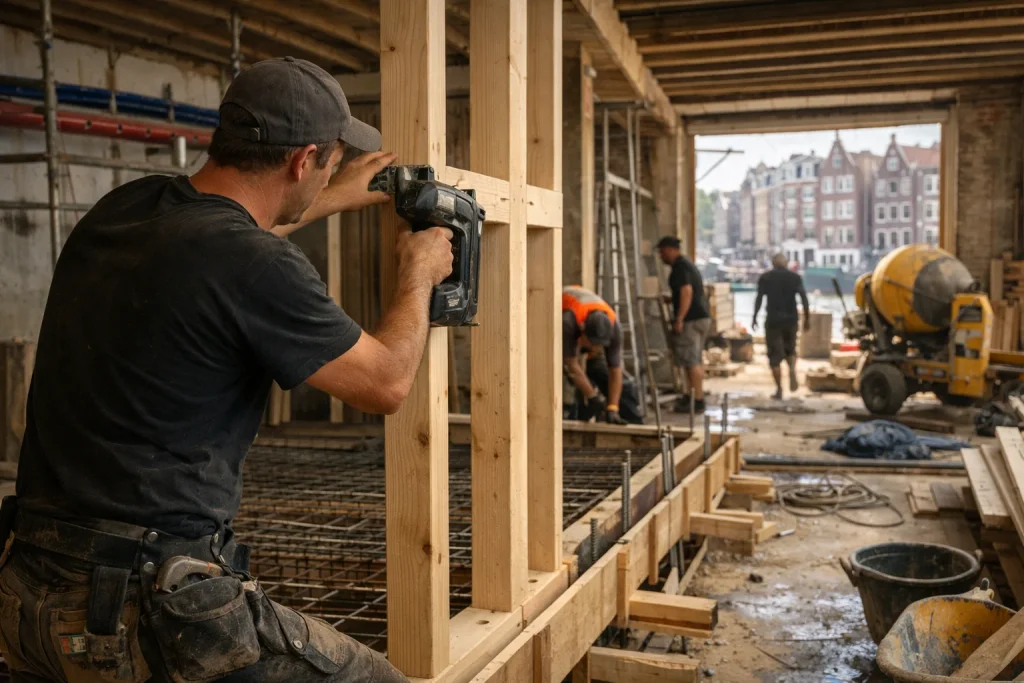
A foreign carpenter arriving in Amsterdam will first confirm their legal right to work. EU/EEA workers can start immediately; non-EU workers wait for permits. They attend VCA safety training, often available online or in person, to meet site requirements. On site, carpenters use standard tools such as circular saws, hammers, drills, and measuring tapes, and wear safety boots, helmets, gloves, and eye protection. Working hours are typically 7 AM to 4 PM, Monday to Friday, with occasional overtime. Commuting is mostly by bike or tram. Housing availability varies; many carpenters share accommodations or live in suburbs due to high city center rents. Employment contracts follow CAO Bouw & Infra, ensuring fair pay and working conditions.
| Aspect | EU/EEA/Swiss Workers | Non-EU Workers |
|---|---|---|
| Work Permit | Not required | Required before starting work |
| Residence Permit | Not required | Required |
| VCA Certification | Often mandatory | Often mandatory |
| Language Requirement | Basic Dutch recommended | Basic Dutch recommended |
| Typical Salary (gross/month) | Depends on experience / CAO | Depends on experience / CAO |
| Housing Cost (monthly) | Varies; often shared accommodation | Varies; often shared accommodation |
| Common Carpenter Jobs in Amsterdam | Description |
|---|---|
| Framing Carpenter | Building wooden frameworks for walls, floors, and roofs |
| Joiner | Crafting doors, windows, cabinetry, and custom woodwork |
| Renovation Carpenter | Restoring and modifying existing structures, often historic buildings |
| Installation Carpenter | Installing wood paneling, flooring, stairs, and fixtures |
| VCA Certification Types | Description |
|---|---|
| VCA Basic | For workers performing basic safety tasks on construction sites |
| VCA VOL | For supervisors and foremen responsible for safety |
| VCA for Leaders | For site managers and safety coordinators overseeing multiple teams |
Frequently asked questions
Do I need a work permit to work as a carpenter in Amsterdam?
What is the average salary for carpenters in Amsterdam?
Is VCA certification mandatory for carpenters in Amsterdam?
How important is Dutch language proficiency for carpenters?
What are the typical working hours for carpenters in Amsterdam?
How can I validate my foreign carpentry qualifications in the Netherlands?
What tools and protective equipment should I bring?
How do carpenters usually commute in Amsterdam?
Is housing easy to find for foreign carpenters in Amsterdam?
What collective labor agreements apply to carpenters in Amsterdam?
Conclusion
Foreign carpenters seeking work in Amsterdam should first clarify their work permit requirements based on nationality. EU/EEA and Swiss nationals can start quickly, while non-EU workers must secure permits beforehand. Obtaining VCA certification and learning basic Dutch enhances safety and job prospects. Understanding pay, working hours, and commuting options helps with planning. Housing is a significant challenge due to high costs and limited availability, so early arrangements are essential. Recruitment agencies like Haldu Groep provide valuable support navigating the Dutch construction labor market, including assistance with housing. Adhering to Dutch labor laws and CAO agreements ensures fair treatment and career growth in Amsterdam’s vibrant carpentry sector.
