
Direct answer
Foreign bricklayers can work in Rotterdam, but non-EU/EEA/Swiss citizens must have a valid Dutch work permit and residence permit before starting employment. EU/EEA and Swiss nationals have the right to work freely without permits. Pay for bricklayers in Rotterdam is generally higher than in many other European cities, depending on experience, contract type, and collective labor agreements (CAOs). Projects include residential, commercial, and infrastructure construction. Basic Dutch or English language skills improve safety and communication. VCA safety certification is commonly required. Agencies like Haldu Groep assist foreign workers with job placement and housing, typically offering private bedrooms in shared accommodations. Rotterdam’s excellent public transport and bike infrastructure support easy commuting to construction sites.
Key points
- Non-EU bricklayers need valid Dutch work and residence permits; EU/EEA/Swiss workers do not.
- Bricklayer pay in Rotterdam is competitive, often higher than many European countries, depending on CAO and experience.
- Common projects include housing developments, commercial buildings, and public infrastructure.
- Basic Dutch or English language skills are essential for safety and communication.
- VCA safety certification is often mandatory on Rotterdam construction sites.
- Housing varies; agencies like Haldu Groep usually provide well-arranged shared housing with private rooms.
- Working hours and contracts follow Dutch labor laws and CAO Bouw & Infra agreements.
- Rotterdam’s public transport and bike infrastructure make commuting convenient.
- Foreign qualifications should be validated or supplemented with Dutch vocational training.
- Mandatory personal protective equipment (PPE) includes helmet, safety boots, gloves, and high-visibility vest.
- Career progression opportunities exist through experience and additional training.
- Understanding contract terms and labor rights is crucial before starting work.
Field expertise
Since 1999, Haldu Groep has specialized in placing skilled construction workers, including bricklayers, in the Netherlands. The Dutch construction sector is regulated by collective labor agreements such as CAO Bouw & Infra, which define wages, working hours, and safety standards. VCA certification is widely required to ensure workers understand safety protocols, reducing accidents on site. Rotterdam’s construction market is dynamic, with ongoing urban development, residential projects, and infrastructure upgrades demanding skilled bricklayers. The city’s extensive public transport and cycling infrastructure support workers commuting from agency-provided housing or nearby areas.
What should you know about bricklayer jobs in Rotterdam: guide for foreign workers?
Bricklayer jobs in Rotterdam are accessible to foreign workers who meet legal and professional requirements. Non-EU citizens must obtain a Dutch work permit and residence permit before employment, while EU/EEA and Swiss nationals can work freely. Pay depends on experience, contract type, and collective labor agreements. Language skills in Dutch or English are important for safety and teamwork. VCA safety certification is often required to access construction sites. Housing arrangements vary; agencies like Haldu Groep typically provide shared housing with private bedrooms near work locations. Rotterdam’s projects include new residential buildings, commercial developments, infrastructure works, and historic restorations, offering diverse work environments.
How does bricklayer jobs in Rotterdam: guide for foreign workers work in practice?
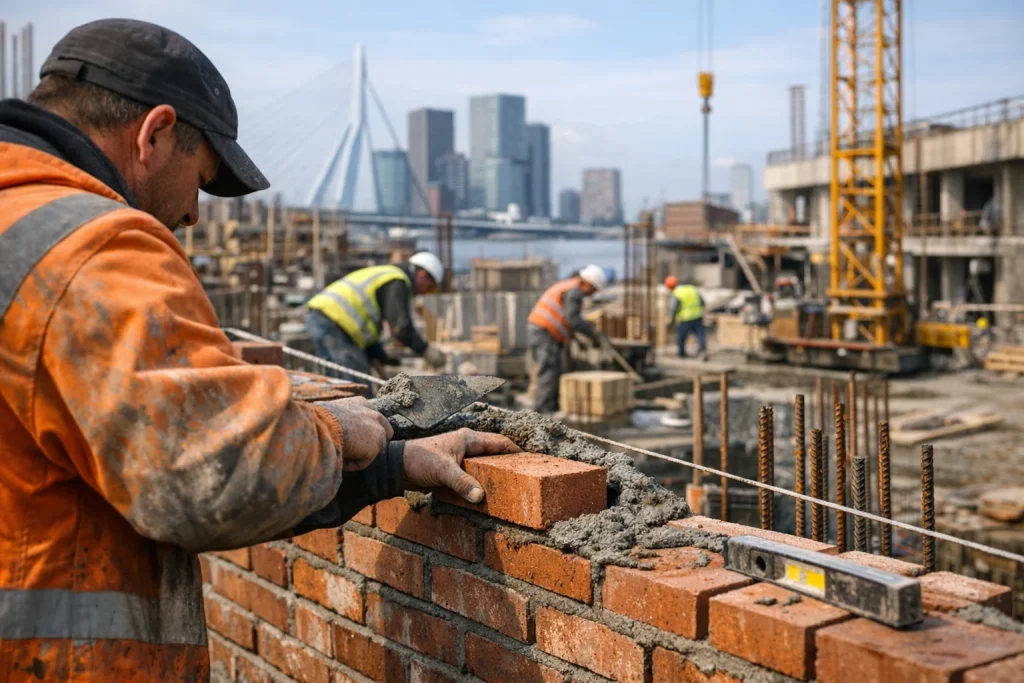
Foreign bricklayers usually apply through agencies that handle legal paperwork, job placement, and housing. After verifying qualifications and permits, workers receive contracts aligned with Dutch labor laws and CAOs. On site, bricklayers use tools such as trowels, brick hammers, and levels to build walls and masonry structures. Safety is emphasized with mandatory PPE and VCA certification. Typical workdays last 8 hours with possible overtime. Commuting is often by public transport or bike, supported by Rotterdam’s infrastructure. Workers adapt to Dutch construction methods and terminology, improving skills through on-the-job experience or vocational courses.
Which conditions apply for bricklayer jobs in Rotterdam: guide for foreign workers?
Conditions include:
- Legal: Non-EU workers need valid work and residence permits; EU/EEA/Swiss workers do not.
- Contracts: Fixed-term or permanent, following CAO Bouw & Infra standards.
- Pay: Based on experience, CAO rates, and project type; always confirm in writing.
- Working hours: Typically 8 hours/day, 40 hours/week, with paid overtime.
- Safety: VCA certification often required; PPE mandatory (helmet, boots, gloves, vest).
- Housing: Agency-provided or self-arranged; agencies like Haldu Groep typically offer shared housing with private rooms.
- Language: Basic Dutch or English needed for communication and safety.
Which mistakes are common around bricklayer jobs in Rotterdam: guide for foreign workers?
Common mistakes include:
- Starting work without valid Dutch work and residence permits (for non-EU workers).
- Underestimating the importance of VCA safety certification for site access.
- Not verifying contract terms or pay details before accepting a job.
- Ignoring language requirements, leading to safety risks and communication problems.
- Failing to validate foreign bricklaying qualifications or not pursuing Dutch vocational training.
- Assuming housing is always provided; arrangements vary by agency and employer.
- Not using mandatory PPE on site, risking fines or accidents.
- Overlooking commuting logistics, causing late arrivals or fatigue.
How do you proceed step by step?
- Check your nationality: EU/EEA/Swiss citizens proceed without permits; non-EU workers must apply for work and residence permits.
- Prepare your CV highlighting bricklaying experience and qualifications.
- Obtain or renew VCA safety certification if required.
- Contact agencies like Haldu Groep for job placement and housing options.
- Validate foreign qualifications through Dutch vocational authorities if needed.
- Learn basic Dutch or English to improve communication on site.
- Review and sign your employment contract, confirming pay, hours, and conditions.
- Arrange or accept agency-provided housing with private bedroom if available.
- Plan your commute using Rotterdam’s public transport or bike infrastructure.
- Start work following safety rules and use mandatory PPE.
What should you check before you start?
- Valid work and residence permits (for non-EU workers).
- Employment contract details: pay, hours, duration, and CAO coverage.
- VCA safety certification validity.
- Housing arrangements and conditions if provided by agency or employer.
- Language skills sufficient for safety instructions and teamwork.
- Personal protective equipment availability and requirements.
- Commuting options and travel time to the construction site.
- Recognition or validation status of your bricklaying qualifications.
What does this look like in practice?
A foreign bricklayer arriving in Rotterdam typically starts by contacting a placement agency. After submitting a CV and verifying legal documents, the agency matches the worker with a suitable construction project. The worker receives a contract aligned with CAO Bouw & Infra, including pay and working hours. Housing is often arranged by the agency, providing a private bedroom in shared accommodation near Rotterdam. On site, the bricklayer uses standard tools like trowels and levels, follows safety protocols with VCA certification, and communicates in Dutch or English. Daily commutes are usually by bike or public transport, supported by Rotterdam’s extensive network. Over time, workers can gain experience and pursue further training or supervisory roles.
| Aspect | EU/EEA/Swiss Workers | Non-EU Workers |
|---|---|---|
| Work Permit | Not required | Required before employment |
| Residence Permit | Not required | Required before employment |
| VCA Certification | Usually required | Usually required |
| Housing | Agency or self-arranged; agencies like Haldu Groep typically provide well-arranged shared housing with private rooms | Often agency-provided with private rooms |
| Language | Basic Dutch/English recommended | Basic Dutch/English recommended |
| Pay | Depends on experience, CAO, and contract; always confirm in writing | Depends on experience, CAO, and contract; always confirm in writing |
| Common Bricklaying Projects in Rotterdam | Details |
|---|---|
| Residential Buildings | New housing developments, apartment blocks, renovations |
| Commercial Buildings | Offices, retail spaces, warehouses |
| Infrastructure | Bridges, tunnels, public transport stations |
| Restoration | Historic building renovations and masonry repairs |
| Typical Working Hours and Contracts | Details |
|---|---|
| Working Hours | Typically 8 hours/day, 40 hours/week, with paid overtime |
| Contract Types | Fixed-term, permanent, temporary agency contracts |
| Collective Labor Agreement | CAO Bouw & Infra applies to most bricklayers |
| Paid Leave | Holiday allowance and statutory leave rights |
| Mandatory Personal Protective Equipment (PPE) | Purpose |
|---|---|
| Helmet | Head protection from falling objects |
| Safety Boots | Foot protection with steel toe caps |
| Gloves | Hand protection from sharp tools and materials |
| High-Visibility Vest | Visibility on busy construction sites |
| Eye Protection | Protection from dust and debris |
Frequently asked questions
Do I need a work permit to work as a bricklayer in Rotterdam?
How much do bricklayers earn in Rotterdam compared to other European cities?
What types of construction projects will I work on as a bricklayer in Rotterdam?
Is housing provided for foreign bricklayers in Rotterdam?
What language skills do I need for bricklayer jobs in Rotterdam?
How can I validate my foreign bricklaying qualifications in the Netherlands?
What are the typical working hours and contract types for bricklayers in Rotterdam?
Is VCA safety certification required for bricklayers in Rotterdam?
How do work rights differ between EU/EEA/Swiss and non-EU bricklayers?
What role do agencies like Haldu Groep play for foreign bricklayers?
Conclusion
Foreign bricklayers seeking work in Rotterdam should ensure they meet legal requirements, including work permits for non-EU nationals and VCA safety certification. Agencies like Haldu Groep can simplify job placement and housing arrangements, often providing private rooms in shared accommodations. Understanding Dutch labor laws, CAO conditions, and basic language skills improves job safety and integration. Rotterdam offers diverse projects and good commuting options, making it an attractive city for skilled bricklayers. Validating qualifications and pursuing further training can enhance career prospects in this dynamic construction market.
