
Direct answer
Carpenter jobs in Leiden are accessible to foreign workers, with EU/EEA/Swiss citizens able to work without a permit, while non-EU citizens must secure a valid Dutch work permit before employment. Pay varies depending on experience, contract type, and collective labor agreements (CAOs), and Dutch construction wages are often higher than in many other European countries, though balanced by local living costs. Common carpentry work in Leiden includes residential renovations, commercial fit-outs, and historic restorations. Basic Dutch language skills and VCA safety certification are typically required. Housing arrangements depend on the placement or agency; with Haldu Groep, housing is typically well arranged, often including a private bedroom for the worker. Leiden’s compact city layout supports commuting by bike or public transport. Understanding Dutch labor laws, CAO agreements, and safety standards is essential for a smooth working experience.
Key points
- EU/EEA/Swiss carpenters do not require a work permit; non-EU carpenters must obtain one before starting work.
- Pay depends on experience, CAO agreements, contract type, and project complexity.
- Common projects include residential renovations, commercial fit-outs, and historic building restoration.
- Basic Dutch language skills are recommended and often required for safety and communication.
- VCA safety certification is usually mandatory on Dutch construction sites.
- Housing arrangements depend on the agency or employer; with Haldu Groep, housing is typically well arranged, usually with private bedrooms.
- Leiden’s compact urban area facilitates commuting by bike or public transport.
- Contracts range from temporary to permanent, with regulated working hours and overtime compensation.
- Foreign qualifications may require validation or additional training to meet Dutch standards.
- Language and integration programs help foreign carpenters adapt to the local work environment.
- Common challenges include language barriers, administrative procedures, and cultural differences.
- Safety equipment and adherence to Dutch safety regulations are strictly enforced.
Field expertise
Since 1999, Haldu Groep has specialized in placing carpenters and other construction workers in the Netherlands, including Leiden. The company supports foreign workers by matching them with suitable jobs, arranging housing, and providing guidance on Dutch labor laws and safety requirements. Leiden’s carpentry sector is influenced by its historic architecture and ongoing urban development, requiring skilled workers for both restoration and new construction projects. Dutch collective labor agreements (CAOs), such as CAO Bouw & Infra, regulate pay and working conditions to ensure fair treatment. Safety training, including VCA certification, is standard to maintain workplace safety. Leiden’s compact city layout encourages sustainable commuting by bike or public transport.
What should you know about carpenter jobs in Leiden: guide for foreign workers?
Carpentry jobs in Leiden involve a variety of tasks such as constructing wooden frameworks, cabinetry, and restoring historic buildings. Foreign workers must understand legal requirements, including work permits for non-EU citizens and the importance of safety certifications like VCA. Practical experience and recognized qualifications are highly valued; foreign diplomas often require validation through Dutch recognition services. While Dutch language skills are not always mandatory, they significantly improve communication and safety on site. Housing arrangements depend on the employer or agency, helping foreign workers settle quickly. Leiden’s projects combine modern construction with historic preservation, reflecting the city’s rich architectural heritage.
How does carpenter jobs in Leiden: guide for foreign workers work in practice?
Foreign carpenters usually apply through recruitment agencies or directly with construction companies. EU/EEA/Swiss workers can start immediately after registration, while non-EU workers must secure a work permit before employment. Upon hiring, carpenters receive contracts aligned with CAO Bouw & Infra, detailing pay, working hours, and conditions. Safety training, including VCA certification, is completed early to comply with Dutch regulations. Housing is often provided by agencies like Haldu Groep, offering private rooms in shared accommodations. Daily tasks involve using tools such as circular saws, chisels, and drills on projects ranging from residential renovations to commercial fit-outs. Commuting is usually by bike or public transport due to Leiden’s compact size.
Which conditions apply for carpenter jobs in Leiden: guide for foreign workers?
Carpenter jobs in Leiden are governed by Dutch labor law and collective agreements like CAO Bouw & Infra. Standard working hours are typically around 40 per week, with overtime compensated according to CAO rules. Contracts may be temporary or permanent and often include probation periods. Pay scales depend on experience, certifications, and job complexity. Safety regulations require personal protective equipment (PPE) such as helmets, gloves, safety boots, eye, and hearing protection. VCA certification is often mandatory before starting work. Language requirements vary, but basic Dutch is commonly needed for effective communication and safety compliance.
Which mistakes are common around carpenter jobs in Leiden: guide for foreign workers?
Common mistakes include starting work without the proper work permit (for non-EU workers), underestimating the importance of VCA certification, and lacking basic Dutch language skills. Some foreign carpenters fail to validate their qualifications, leading to job mismatches or lower pay. Others do not fully understand Dutch labor contracts and CAO terms, causing confusion about pay or working hours. Housing arrangements can cause problems if not confirmed before arrival. Neglecting safety rules or PPE requirements can result in accidents or dismissal.
How do you proceed step by step?
- Check if you need a work permit based on your nationality.
- Prepare a clear CV highlighting your carpentry skills and experience.
- Validate your qualifications if necessary through Dutch recognition services.
- Apply for jobs via agencies like Haldu Groep or directly with construction companies.
- Obtain VCA safety certification before starting work.
- Arrange housing through your employer or agency.
- Learn basic Dutch to improve communication and safety on site.
- Understand your contract and CAO terms before signing.
- Start work with proper PPE and follow safety protocols.
- Use public transport or bike for commuting within Leiden.
What should you check before you start?
- Validity of your work permit (if applicable).
- Recognition or validation of your carpentry qualifications.
- Status of your VCA safety certification.
- Details of your employment contract and CAO coverage.
- Housing arrangements and living conditions.
- Availability and provision of required personal protective equipment.
- Basic Dutch language skills or access to language courses.
- Commute options and travel time to the work site.
- Insurance coverage and worker rights under Dutch law.
What does this look like in practice?
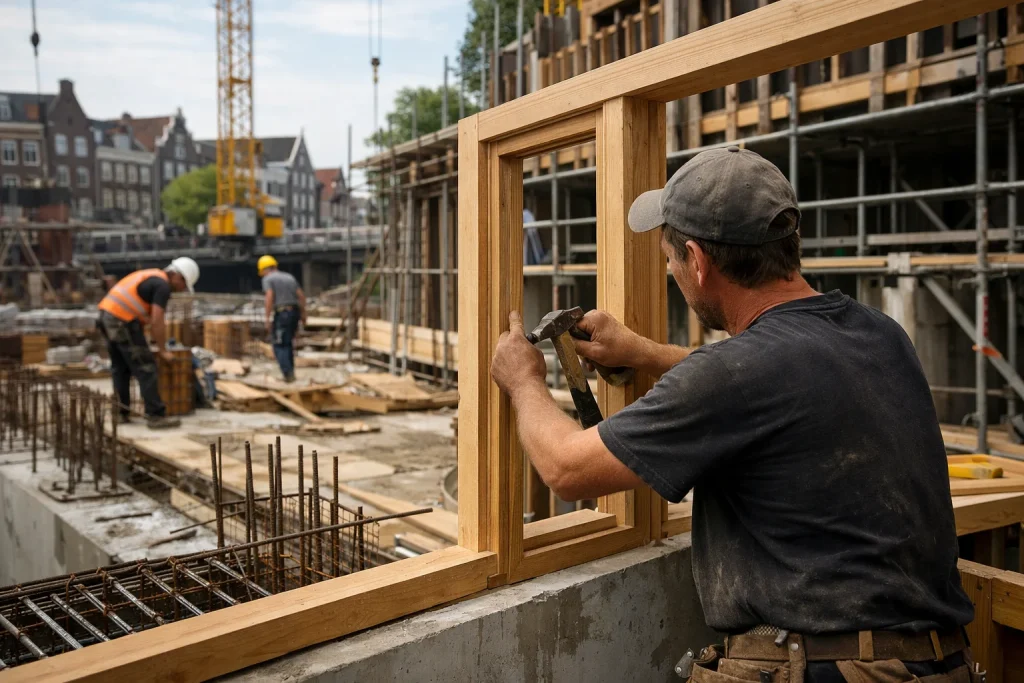
A foreign carpenter arriving in Leiden might first register with an agency like Haldu Groep, which helps find a suitable job and arranges housing with private bedrooms. After confirming work permit status, the carpenter completes VCA safety training, often organized by the employer. On site, the carpenter uses standard tools such as circular saws and chisels to work on projects like renovating a historic canal house or fitting out a new office space. Communication is mostly in Dutch, so basic language skills are essential. The carpenter commutes by bike, benefiting from Leiden’s compact city layout. Contracts follow CAO Bouw & Infra, ensuring fair pay and regulated hours. PPE is worn at all times to comply with safety standards.
| Aspect | EU/EEA/Swiss Carpenter | Non-EU Carpenter |
|---|---|---|
| Work Permit | Not required | Required before starting work |
| Language Requirement | Basic Dutch recommended | Basic Dutch often required |
| VCA Certification | Usually mandatory | Mandatory |
| Housing | Often arranged by agency | Often arranged by agency |
| Contract Type | Temporary or permanent | Temporary or permanent |
| Project Type | Description | Common Tools |
|---|---|---|
| Residential Renovation | Updating homes, wooden flooring, cabinetry | Circular saw, hammer, measuring tape |
| Commercial Fit-Out | Installing wooden partitions, fixtures in offices | Power drill, chisel, level |
| Historical Restoration | Repairing timber frames, wood paneling in old buildings | Wood carving tools, hand saw, clamps |
| Certification | Purpose | Requirement Level |
|---|---|---|
| VCA Basic | Basic safety awareness | Often minimum requirement |
| VCA VOL | Safety for supervisors and experienced workers | Required for senior roles |
| MBO Bouwkunde | Vocational training in construction | Preferred or required for some jobs |
Frequently asked questions
Do I need a work permit to work as a carpenter in Leiden?
How much do carpenters in Leiden typically earn?
What types of carpentry projects are common in Leiden?
Is Dutch language knowledge mandatory for carpenter jobs?
What certifications do I need to work as a carpenter in Leiden?
How is housing arranged for foreign carpenters in Leiden?
What is the role of Haldu Groep in placing carpenters?
Are there collective labor agreements (CAOs) for carpenters in Leiden?
What personal protective equipment (PPE) is standard for carpenters?
How do carpenters usually commute in Leiden?
Conclusion
Foreign carpenters seeking work in Leiden should first confirm their work permit status and secure necessary certifications such as VCA. Basic Dutch language skills enhance safety and communication on site. Employment agencies like Haldu Groep provide valuable support with job placement and housing arrangements, often including private bedrooms. Understanding CAO agreements ensures fair pay and regulated working conditions. Leiden’s compact city layout favors sustainable commuting by bike or public transport. Careful preparation and compliance with Dutch labor laws and safety standards will help foreign carpenters integrate successfully into Leiden’s vibrant construction sector. For more information, consult Haldupedia articles on Work permits for foreign construction workers in the Netherlands and VCA certification: safety training for Dutch construction workers.
