
Direct answer
Concrete carpenter jobs in the Netherlands are accessible to foreign workers, with EU/EEA/Swiss citizens allowed to work freely without permits due to EU freedom of movement. Non-EU nationals must obtain a valid work and residence permit before employment. The Dutch construction sector values skilled concrete carpenters and offers wages generally higher than many European countries, reflecting local labor standards and living costs. Safety certifications like VCA and basic Dutch language skills are often required to ensure workplace safety and effective communication. Housing availability and arrangements vary by placement and region; with Haldu Groep, housing is typically well arranged, often including a private bedroom for the worker. Larger cities offer more job opportunities but also higher living costs. Recruitment agencies such as Haldu Groep provide essential support for foreign workers in job placement, legal compliance, and integration.
Key points
- EU/EEA/Swiss citizens can work as concrete carpenters in the Netherlands without work permits.
- Non-EU workers must secure work and residence permits before employment.
- Concrete carpenters earn wages generally higher than many European countries, reflecting Dutch labor standards and living costs; exact pay depends on role, experience, CAO/collective agreement, region, and contract.
- VCA safety certification is commonly required for construction site work.
- Basic Dutch language skills improve safety, communication, and job prospects.
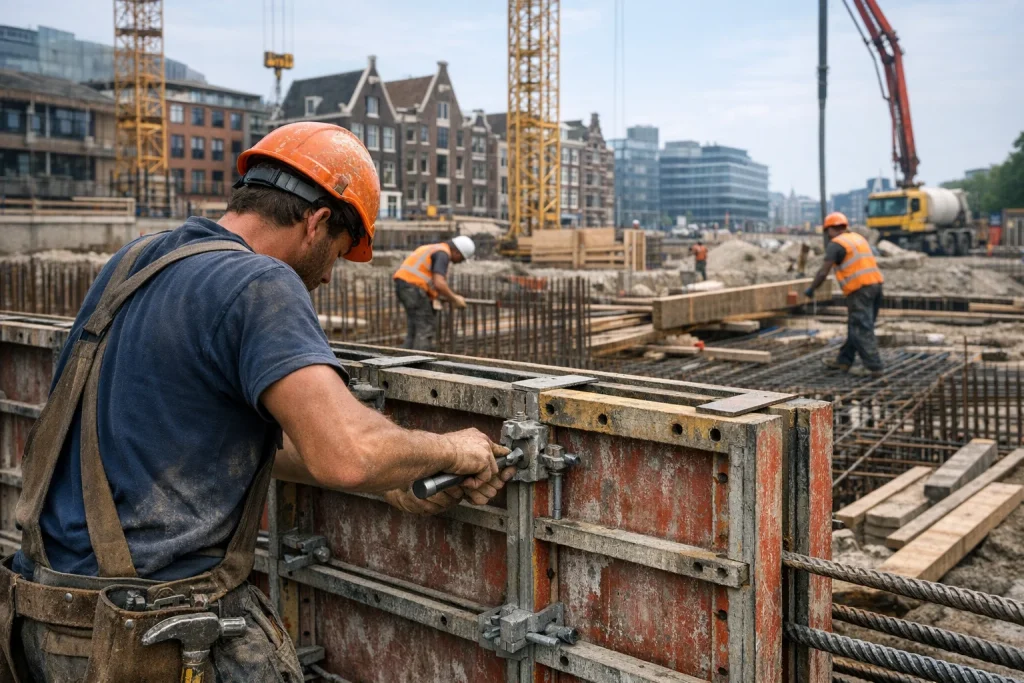
- Typical tasks include assembling formwork, installing reinforcement bars, and assisting with concrete pouring.
- The CAO Bouw & Infra collective labor agreement governs wages, working hours, and conditions.
- Personal protective equipment (PPE) such as helmets, boots, gloves, and high-visibility clothing is mandatory.
- Housing arrangements depend on the placement or agency; with Haldu Groep, housing is typically well arranged, including private bedrooms.
- Recruitment agencies support foreign workers with permits, contracts, and housing advice.
- Apprenticeships and training programs are available to develop skills and certifications.
- Commuting options include bicycles, public transport, and company shuttles.
Field expertise
Since 1999, Haldu Groep has specialized in connecting foreign workers with Dutch construction employers, including concrete carpenters. The Dutch construction sector requires skilled formwork carpenters who build and dismantle molds, install steel reinforcement bars, and assist with concrete casting. Employment follows Dutch labor laws and collective agreements such as CAO Bouw & Infra, ensuring fair wages and safe working conditions. Safety certifications like VCA are standard, and language skills are increasingly important for compliance and teamwork. Haldu Groep offers practical support for work permits, housing arrangements, and integration, helping foreign workers adapt to the Dutch labor market and succeed in their roles.
What should you know about concrete carpenter jobs in the netherlands for foreign workers?
Concrete carpenters, also called formwork carpenters, construct temporary wooden or metal molds (bekisting) that shape poured concrete structures. In the Netherlands, EU/EEA/Swiss citizens benefit from freedom of movement and can work without permits. Non-EU workers must obtain work and residence permits through the Dutch Immigration and Naturalisation Service (IND).
The Dutch construction sector is a significant employer, with steady demand for skilled carpenters on infrastructure, residential, and commercial projects. Concrete carpenters assemble formwork panels, install steel reinforcement bars (wapening), pour concrete (storten), and finish surfaces (afwerken). Safety is a priority, requiring personal protective equipment (PPE) and often a VCA safety certificate.
Basic Dutch or English language skills help workers understand instructions and safety protocols. Employers prefer candidates with some Dutch to improve site communication. Housing arrangements vary by placement; costs differ widely, with cities like Amsterdam, Rotterdam, and Utrecht being more expensive but offering more job opportunities.
How does concrete carpenter jobs in the netherlands for foreign workers work in practice?
Foreign concrete carpenters usually find jobs through recruitment agencies, online job portals, or direct employer contacts. EU/EEA/Swiss workers can start immediately after registering for a BSN number (Dutch citizen service number). Non-EU workers must apply for a work permit (TWV) and residence permit before arrival or employment.
Employment contracts follow the CAO Bouw & Infra or similar collective agreements, regulating wages, working hours, and conditions. Standard workdays are 8 hours, with overtime paid according to the CAO. Workers attend safety briefings and wear PPE such as helmets, gloves, boots, and high-visibility clothing.
Daily tasks include measuring and cutting formwork panels, assembling molds, fixing steel reinforcement bars, and assisting with concrete pouring and curing. Teams use modular formwork systems or traditional timber molds depending on the project.
Housing arrangements depend on the placement or agency; some agencies and employers offer temporary accommodation. With Haldu Groep, housing is typically well arranged, including private bedrooms. Commuting is often by bicycle, public transport, or company shuttle buses.
Which conditions apply for concrete carpenter jobs in the netherlands for foreign workers?
| Condition | EU/EEA/Swiss Workers | Non-EU Workers |
|---|---|---|
| Work Permit | Not required | Required before starting work |
| Residence Permit | Not required | Required |
| VCA Certification | Often required | Often required |
| Dutch Language | Basic skills recommended | Basic skills recommended |
| Contract Type | Standard labor contracts under CAO | Standard labor contracts under CAO |
| Working Hours | Typically 8 hours/day, 40 hours/week | Typically 8 hours/day, 40 hours/week |
| Safety Equipment | Mandatory PPE | Mandatory PPE |
Employers must comply with Dutch labor laws and collective agreements, ensuring fair pay and safe working conditions. Foreign workers should verify their contracts and understand their rights.
Which mistakes are common around concrete carpenter jobs in the netherlands for foreign workers?
- Starting work without the correct permits (for non-EU workers), risking fines or deportation.
- Underestimating the importance of VCA safety certification, limiting job opportunities.
- Neglecting Dutch language learning, causing safety risks and communication problems.
- Failing to research housing options before arrival, leading to high costs or poor living conditions.
- Not understanding the CAO labor agreements, resulting in missed rights or incorrect pay.
- Ignoring the need for proper personal protective equipment (PPE) on site.
- Applying to jobs without a well-prepared CV highlighting relevant carpentry and safety experience.
- Not verifying the legitimacy of recruitment agencies or employers.
How do you proceed step by step?
- Check your nationality: EU/EEA/Swiss or non-EU.
- If non-EU, apply for a work permit and residence visa via the Dutch embassy or IND.
- Prepare a CV emphasizing concrete carpentry skills and any safety certifications.
- Learn basic Dutch or English to improve communication and safety compliance.
- Obtain VCA certification if possible before applying.
- Search for jobs through agencies like Haldu Groep, online portals, or direct employer contacts.
- Review and sign a contract under Dutch labor laws and CAO agreements.
- Arrange housing near your job location; consider temporary options if needed.
- Start work with proper PPE and follow safety procedures.
- Consider apprenticeship or training programs for career growth.
What should you check before you start?
- Valid work and residence permits (if applicable).
- Signed employment contract aligned with CAO Bouw & Infra.
- VCA safety certification or proof of training.
- Basic knowledge of Dutch or English for site communication.
- Availability and condition of personal protective equipment (helmet, boots, gloves).
- Housing arrangements and commuting options.
- Understanding of job tasks and employer expectations.
- Health insurance coverage in the Netherlands.
What does this look like in practice?
A concrete carpenter from Romania, an EU citizen, finds a job in Amsterdam through Haldu Groep. He registers for a BSN number and opens a Dutch bank account. Holding a VCA certificate and basic Dutch skills, he signs a contract under the CAO Bouw & Infra, earning a salary that depends on experience and the collective agreement.
He rents a room in a shared apartment near the construction site. Each day, he wears PPE and attends a safety briefing. His tasks include assembling formwork panels, fixing steel reinforcement bars, and assisting with concrete pouring. Communication happens in simple Dutch and English among a diverse team. After several months, he enrolls in a training program to improve his skills and career prospects.
| Typical Monthly Gross Salary | Low Experience | Medium Experience | High Experience |
|---|---|---|---|
| Concrete Carpenter | Depends on experience / CAO | Depends on experience / CAO | Depends on experience / CAO |
| Common PPE for Concrete Carpenters | Description | Purpose |
|---|---|---|
| Safety Helmet | Hard hat certified for construction | Protects head from falling objects |
| Safety Boots | Steel-toe, slip-resistant boots | Protects feet from heavy objects and slips |
| High-Visibility Clothing | Reflective vests or jackets | Improves visibility on site |
| Gloves | Durable work gloves | Protects hands from cuts and abrasions |
| Hearing Protection | Earplugs or earmuffs | Protects hearing from loud machinery |
Frequently asked questions
Do I need a work permit to work as a concrete carpenter in the Netherlands?
What is the average salary for concrete carpenters in the Netherlands?
Is VCA certification mandatory for concrete carpenter jobs?
How much Dutch do I need to work on a construction site?
Are there apprenticeship programs for foreign concrete carpenters?
Can I find housing easily as a foreign worker in the Netherlands?
What personal protective equipment is required?
How many hours do concrete carpenters work per week?
Does the Dutch collective labor agreement apply to foreign workers?
How can Haldu Groep help foreign concrete carpenters?
Conclusion
Foreign concrete carpenters can successfully find jobs in the Netherlands by understanding work permit requirements, safety certifications, and labor agreements. EU/EEA/Swiss workers have easier access, while non-EU workers must secure permits before arrival. Learning basic Dutch and obtaining VCA certification improve job prospects and safety. Planning housing and commuting is essential for a smooth transition. Support from agencies like Haldu Groep can help navigate the Dutch construction market. With proper preparation, foreign concrete carpenters can build a rewarding career in the Netherlands.
