
Direct answer
Utility electrician jobs in Rotterdam are accessible to foreign workers, with EU/EEA/Swiss citizens able to work without a permit, while non-EU nationals must obtain a Dutch work and residence permit before starting. Pay follows Dutch CAO agreements and varies by experience, role, and contract type. Safety certification such as VCA is generally required, and basic Dutch language skills are recommended though English is widely used on site. Employers or staffing agencies often arrange housing, typically offering private bedrooms in shared accommodations. Rotterdam’s large port, ongoing infrastructure projects, and excellent public transport make it a practical and attractive city for foreign utility electricians seeking employment.
Key points
- EU/EEA/Swiss citizens can work in Rotterdam without a permit; non-EU workers need a valid Dutch work and residence permit.
- Pay depends on experience, role, Dutch CAO agreements, and contract type.
- VCA safety certification is generally mandatory for utility electrician jobs.
- Basic Dutch language skills improve communication; English is commonly used on site.
- Typical projects include port electrification, urban energy networks, and infrastructure upgrades.
- Rotterdam offers excellent commuting options: bike, public transport, and car.
- Housing is often arranged by employers or agencies; Haldu Groep typically provides private bedrooms in shared housing.
- Foreign qualifications must be validated by Dutch authorities; additional training may be required.
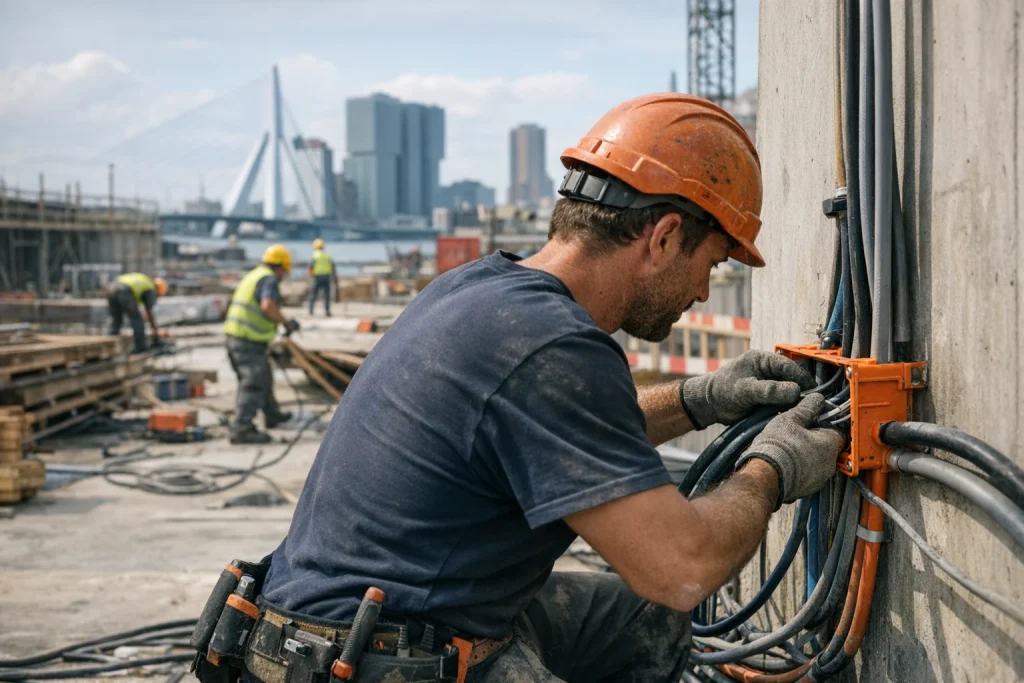
- Personal protective equipment (PBM) such as helmets, insulated gloves, boots, and high-visibility clothing is mandatory.
- Contracts range from temporary to permanent with standard Dutch working hours and possible overtime.
- Integration programs and language courses support foreign workers’ adaptation.
- Challenges include language barriers, qualification recognition, and adapting to Dutch safety standards.
Field expertise
Since 1999, Haldu Groep has specialized in placing skilled electricians in the Netherlands, including utility electricians in Rotterdam. The company supports foreign workers by arranging housing, ensuring compliance with Dutch labor laws, and facilitating access to certifications such as VCA. Utility electricians in Rotterdam work on diverse projects involving low and high voltage systems, cable laying, and installation of utility meters. Dutch CAO agreements for construction and metal sectors regulate pay and working conditions, providing a structured framework for employment. Rotterdam’s infrastructure and port activities create steady demand for qualified electricians, making it a key city for foreign workers in this trade.
What should you know about utility electrician jobs in Rotterdam: guide for foreign workers?
Utility electrician jobs in Rotterdam require knowledge of local labor laws, safety regulations, and the city’s specific project types. EU/EEA/Swiss workers can start immediately without permits, while non-EU electricians must secure a work and residence permit. The Dutch CAO (Collective Labor Agreement) influences wages and working conditions, often offering better pay than many European countries. Safety certifications, especially VCA, are mandatory to meet Dutch regulations. Rotterdam’s projects often focus on port electrification, urban energy networks, and infrastructure upgrades, requiring skills in cable laying, electrical testing, and installation of distribution boards. Housing is usually arranged by employers or agencies, with Haldu Groep known for providing private bedrooms in shared accommodations. Basic Dutch improves communication, but English is widely accepted on site.
How does utility electrician jobs in Rotterdam: guide for foreign workers work in practice?
In practice, foreign utility electricians begin by validating their qualifications and obtaining necessary certifications like VCA. EU/EEA workers can apply directly for jobs, while non-EU electricians must first secure a work permit. Employment contracts vary from temporary to permanent, with working hours typically around 40 per week plus possible overtime. Daily commuting in Rotterdam is flexible, with many workers using bikes, public transport, or cars. Safety equipment such as helmets, insulated gloves, and boots are mandatory on site. Housing arrangements depend on the employer or staffing agency; Haldu Groep often provides well-organized housing with private rooms. Language barriers are common but manageable with basic Dutch or English.
Which conditions apply for utility electrician jobs in Rotterdam: guide for foreign workers?
Conditions include legal work rights, safety compliance, and adherence to Dutch labor laws. EU/EEA/Swiss citizens have unrestricted work access, while non-EU electricians need a valid work and residence permit. The Dutch CAO Bouw & Infra or CAO Metaal en Techniek governs pay scales, working hours, and benefits. VCA certification is often compulsory for safety on utility projects. Employers provide personal protective equipment (PBM) such as helmets, gloves, boots, and high-visibility clothing. Contracts may be temporary or permanent, with standard working hours around 40 per week. Housing is typically arranged by employers or agencies, with costs varying by location and type. Basic Dutch language skills are recommended to understand safety instructions and communicate effectively.
Which mistakes are common around utility electrician jobs in Rotterdam: guide for foreign workers?
- Failing to secure the correct work permit before starting (for non-EU workers).
- Underestimating the importance of VCA safety certification.
- Not validating foreign qualifications with Dutch authorities.
- Ignoring the need for basic Dutch language skills to improve communication and safety.
- Assuming housing will always be provided without confirming arrangements.
- Overlooking the Dutch CAO agreements that affect pay and working conditions.
- Not preparing for the cost of living in Rotterdam, which can be higher than in home countries.
- Neglecting to use proper personal protective equipment on site.
How do you proceed step by step?
- Check your nationality: EU/EEA/Swiss or non-EU to determine permit needs.
- Validate your electrician qualifications with Dutch authorities or recognized bodies.
- Obtain necessary safety certifications, especially VCA.
- Apply for jobs through agencies like Haldu Groep or directly with employers.
- If non-EU, apply for a Dutch work and residence permit before starting work.
- Arrange housing through your employer, agency, or independently; with Haldu Groep, housing is typically well arranged, including a private bedroom.
- Prepare for commuting using Rotterdam’s public transport, bike, or car options.
- Attend any language or integration courses to improve Dutch skills.
- Start work with proper personal protective equipment and follow safety rules.
- Understand your contract terms, pay according to CAO, and working hours.
What should you check before you start?
- Work permit and residence status (if non-EU).
- Validation of your electrician qualifications in the Netherlands.
- Possession of required safety certifications like VCA.
- Details of your employment contract: pay, working hours, and duration.
- Housing arrangements and costs, including utilities and location.
- Availability and condition of personal protective equipment (PBM).
- Language requirements and support options.
- Commuting options and travel time to the worksite.
- Health and safety rules specific to the employer and project.
What does this look like in practice?
A foreign utility electrician arriving in Rotterdam typically starts by confirming their work permit status. If from the EU/EEA, they can begin job applications immediately. Many find work through staffing agencies like Haldu Groep, which often arrange housing with private bedrooms in shared apartments. On site, electricians wear mandatory PBM such as helmets and insulated gloves and work on projects like port electrification or urban energy upgrades. Daily commuting is often by bike or public transport, both well-developed in Rotterdam. Pay is aligned with Dutch CAO agreements and depends on experience and contract type. Language barriers are common but manageable with basic Dutch or English. Safety training and integration courses help workers adapt quickly.
| Aspect | EU/EEA/Swiss Workers | Non-EU Workers |
|---|---|---|
| Work Permit | Not required | Required before work starts |
| Qualification Validation | Recommended | Mandatory |
| VCA Certification | Usually required | Usually required |
| Housing | Arranged by employer or agency | Arranged by employer or agency |
| Language Requirement | Basic Dutch recommended | Basic Dutch recommended |
| Common Utility Projects in Rotterdam | Skills Required |
|---|---|
| Port electrification and maintenance | High voltage systems, cable jointing, safety inspections |
| Urban energy network installations | Low voltage wiring, installation of utility meters, testing |
| Infrastructure upgrades (roads, tunnels) | Cable laying, electrical testing, fault finding |
| Typical Contract Types | Working Hours | Pay Basis |
|---|---|---|
| Temporary (fixed-term) | 40 hours/week + overtime possible | Depends on experience / CAO |
| Permanent (indefinite) | 40 hours/week + overtime possible | Depends on experience / CAO |
Frequently asked questions
Do I need a work permit to work as a utility electrician in Rotterdam?
What certifications are required for utility electricians in Rotterdam?
Is Dutch language fluency mandatory for these jobs?
How does the Dutch CAO affect my pay as a utility electrician?
What types of utility projects will I work on in Rotterdam?
How do I validate my foreign electrician qualifications?
What housing options are available for foreign utility electricians?
What personal protective equipment is mandatory on site?
How do I commute to work in Rotterdam?
What are typical working hours and contract types?
Conclusion
Foreign utility electricians aiming to work in Rotterdam should first verify their work permit status and validate their qualifications. Obtaining VCA certification and learning basic Dutch will enhance job opportunities and safety compliance. Housing is often arranged by employers or agencies like Haldu Groep, easing relocation challenges. Rotterdam’s diverse utility projects and excellent transport infrastructure make it an attractive city for skilled electricians. Understanding Dutch CAO agreements and safety standards is essential for fair pay and safe working conditions. Careful preparation and following the recommended steps will help foreign workers succeed in Rotterdam’s utility electrician sector.
