
Direct answer
Housing electrician jobs in Utrecht are accessible to foreign workers, with EU/EEA/Swiss nationals able to work without a permit, while non-EU citizens must secure a valid Dutch work permit before employment. Pay depends on experience, contract type, and collective labor agreements (CAOs). Housing is often arranged by agencies and usually includes furnished private rooms or shared apartments near job sites. Essential safety certifications such as VCA and NEN 3140 are required. Basic Dutch language skills help but are not always mandatory at the start. Utrecht’s compact city layout supports easy commuting by bike, public transport, or car. Agencies like Haldu Groep assist with job placement and housing, easing the transition for foreign electricians.
Key points
- EU/EEA/Swiss electricians can work in Utrecht without a permit; non-EU workers need a valid Dutch work permit.
- Pay varies by experience, CAO agreements, contract type, and employer; Dutch construction wages are often higher than in many other European countries, though living costs vary by region.
- Housing is often agency-arranged, commonly offering private bedrooms or shared apartments near work sites; with Haldu Groep, housing is typically well arranged, including a private bedroom for the worker.
- VCA and NEN 3140 certifications are standard safety requirements for electricians.
- Basic Dutch language skills improve communication but are not always mandatory initially; English is often accepted.
- Contracts range from temporary to permanent, typically 36-40 hours per week.
- Commuting in Utrecht is convenient by bike, public transport, or car due to the city’s compact size.
- Personal protective equipment (PPE) such as helmets, gloves, and safety boots is mandatory on site.
- Typical projects include residential electrical installations, renovations, and maintenance in housing developments.
- Haldu Groep has supported foreign electricians in Utrecht since 1999, providing job and housing assistance.
- Early housing arrangement is advised due to Utrecht’s competitive housing market.
- Understanding Dutch labor laws and CAO agreements helps ensure fair pay and working conditions.
Field expertise
Since 1999, Haldu Groep has specialized in placing electricians and other technical workers in the Dutch construction sector, including Utrecht’s housing market. The Dutch construction industry operates under collective labor agreements (CAOs) such as CAO Bouw & Infra and CAO Metaal & Techniek, which regulate wages, working hours, and conditions. Safety certifications like VCA (Veiligheid, Gezondheid en Milieu Checklist Aannemers) and NEN 3140 are mandatory for electricians working on housing projects. Vocational training at MBO level 3 or 4 is typically required. Utrecht’s housing projects involve new construction, renovations, and electrical system maintenance, requiring electricians to be skilled in installation, troubleshooting, and safety compliance. The city’s compact size and good infrastructure facilitate commuting and housing arrangements.
What should you know about housing electrician jobs in utrecht: guide for foreign workers?
Foreign electricians should know that EU/EEA/Swiss nationals can work in Utrecht without a permit, while non-EU workers must secure a Dutch work permit. Pay is influenced by CAO agreements, which set minimum wages and working conditions. Housing in Utrecht is competitive due to high demand; agencies often provide furnished rooms or shared apartments near job sites. VCA certification is mandatory for safety compliance on construction sites. Basic Dutch language skills improve communication but are not always required initially. Typical contracts include temporary and permanent roles with standard Dutch working hours. Commuting is easy within Utrecht by bike, public transport, or car. Understanding these factors helps foreign workers prepare for a successful job and living experience in Utrecht.
How does housing electrician jobs in utrecht: guide for foreign workers work in practice?
Foreign electricians typically find jobs through agencies or direct employer contacts. EU/EEA/Swiss workers can start immediately, while non-EU workers must obtain a work permit. Housing is often arranged by the agency or employer, with options including private rooms in shared apartments or single studios. Contracts specify pay, hours, and duration, aligned with CAO standards. Daily tasks include installing electrical wiring, maintaining systems, and conducting safety inspections in residential buildings. PPE such as helmets, gloves, and boots is mandatory. Commuting within Utrecht is convenient by bike or public transport, with many projects located in or near the city center or suburban housing developments.
Which conditions apply for housing electrician jobs in utrecht: guide for foreign workers?
Conditions include legal eligibility to work, possession of required certifications, and compliance with safety regulations. EU/EEA/Swiss nationals do not need work permits; non-EU workers must have a valid permit. VCA and NEN 3140 certifications are required. Contracts may be temporary or permanent, with working hours usually 36-40 per week. Pay is regulated by CAO agreements covering wages, holiday allowance, sick leave, and overtime. Housing conditions depend on employer or agency; many provide furnished rooms with utilities included. Language skills vary, but basic Dutch or English is usually sufficient. PPE is mandatory on site.
Which mistakes are common around housing electrician jobs in utrecht: guide for foreign workers?
- Starting work without verifying work permit requirements.
- Neglecting to obtain VCA and other required safety certifications.
- Submitting a CV not tailored to Dutch standards or lacking certification details.
- Delaying housing arrangements, leading to last-minute difficulties.
- Assuming Dutch fluency is mandatory from day one, limiting job options.
- Ignoring commuting logistics, especially when living outside Utrecht.
- Not confirming contract details such as pay, hours, and benefits before signing.
- Failing to use or bring proper personal protective equipment on site.
How do you proceed step by step?
- Check your eligibility to work in the Netherlands (EU/EEA/Swiss vs non-EU).
- Obtain necessary certifications (VCA, NEN 3140) and prepare a Dutch-style CV.
- Apply for electrician jobs in Utrecht through agencies like Haldu Groep or direct employers.
- If non-EU, secure a valid Dutch work permit before starting work.
- Arrange housing early, either through your agency or independently; with Haldu Groep, housing is typically well arranged, including a private bedroom.
- Review and sign your employment contract, confirming pay, hours, and conditions.
- Prepare or confirm provision of personal protective equipment.
- Plan your commute using Utrecht’s public transport, bike routes, or car options.
- Start work, focusing on safety compliance and communication with your team.
- Consider upskilling opportunities to advance your career in the Dutch construction sector.
What should you check before you start?
- Your legal right to work, including valid work permit if required.
- Recognition and validity of your certifications (VCA, NEN 3140).
- Employment contract details: pay, working hours, benefits.
- Housing arrangements and proximity to your job site.
- Availability and condition of personal protective equipment.
- Language requirements and communication expectations on site.
- Commuting options and estimated travel time.
- Health and safety protocols relevant to your job.
- Contact details for your employer or agency support.
What does this look like in practice?
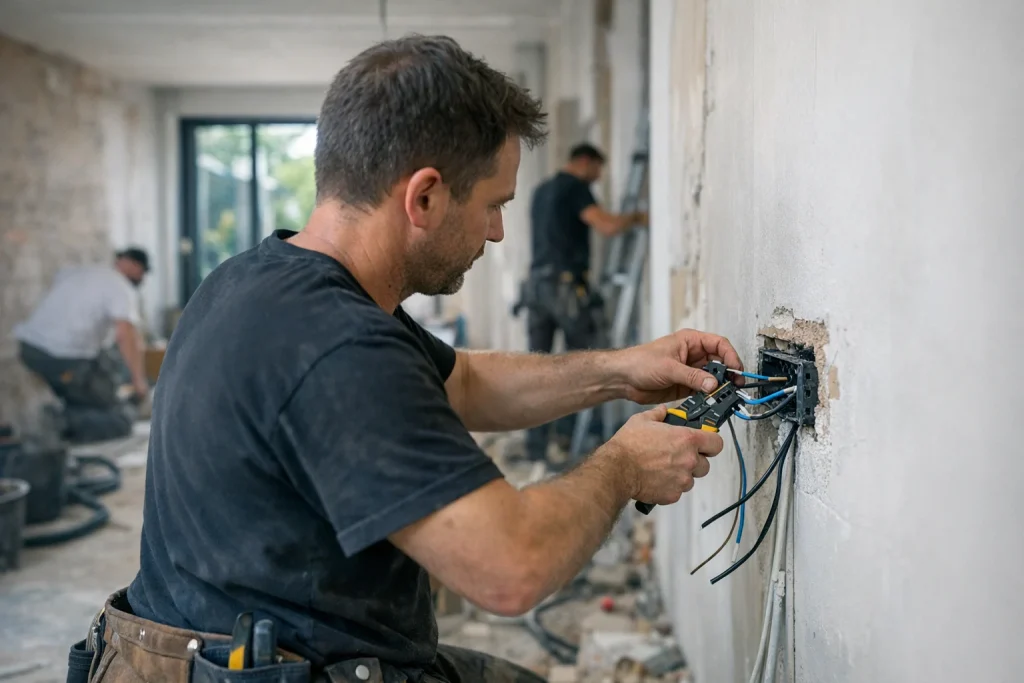
A foreign electrician in Utrecht typically starts the day by cycling or taking public transport to a residential construction site. They wear required PPE such as insulated gloves, safety helmet, and boots. Tasks include installing wiring, circuit breakers, and junction boxes, following NEN 3140 safety standards. Communication with Dutch colleagues may be in simple Dutch or English. Their contract, aligned with CAO Bouw & Infra, ensures fair pay and working hours. Housing is usually a private room arranged by the agency, located within reasonable commuting distance of the job site. Daily routines include safety checks and VCA compliance. Upskilling courses may be available to improve skills and career prospects.
| Aspect | EU/EEA/Swiss Electricians | Non-EU Electricians |
|---|---|---|
| Work Permit | Not required | Required before starting work |
| Contract Types | Temporary or permanent | Temporary or permanent |
| Housing Options | Agency arranged or independent | Agency arranged preferred |
| Language Requirement | Basic Dutch or English | Basic Dutch or English |
| Certifications Required | VCA, NEN 3140 | VCA, NEN 3140 |
| Pay Factors | Influence |
|---|---|
| Experience | Higher experience leads to better pay |
| CAO Agreement | Sets minimum wages and benefits |
| Contract Type | Permanent contracts often pay more |
| Employer | Large firms may offer higher pay |
| Region | Utrecht pay is competitive compared to other Dutch cities |
| Common Housing Types | Details |
|---|---|
| Private Room in Shared Apartment | Most common; includes utilities; agency arranged |
| Single Studio | Less common; higher cost; more privacy |
| Shared Housing with Other Workers | Cost-effective; social support; agency arranged |
| Independent Rental | Requires personal arrangement; more expensive |
Frequently asked questions
Do I need a work permit to work as an electrician in Utrecht?
What certifications are required to work as a housing electrician in Utrecht?
How much can I expect to earn as a housing electrician in Utrecht?
Is Dutch language proficiency mandatory for electrician jobs in Utrecht?
What types of housing are available for foreign electricians in Utrecht?
How do I find reliable housing near my job site in Utrecht?
What are the typical working hours for housing electricians in Utrecht?
What safety equipment must I use on site?
How do I commute to housing electrician jobs in Utrecht?
Can I advance my career as a foreign electrician in Utrecht?
Conclusion
Foreign electricians seeking housing jobs in Utrecht should first confirm their legal work status and obtain necessary certifications like VCA and NEN 3140. Early housing arrangements through agencies such as Haldu Groep ease relocation challenges and typically include private bedrooms. Understanding CAO agreements, contract types, and safety requirements ensures fair pay and safe working conditions. Basic Dutch language skills improve communication but are not always mandatory initially. Utrecht’s compact size and excellent transport infrastructure make commuting straightforward. Preparing a clear Dutch-style CV and following a step-by-step approach will improve job prospects and integration into the Dutch construction sector.
