
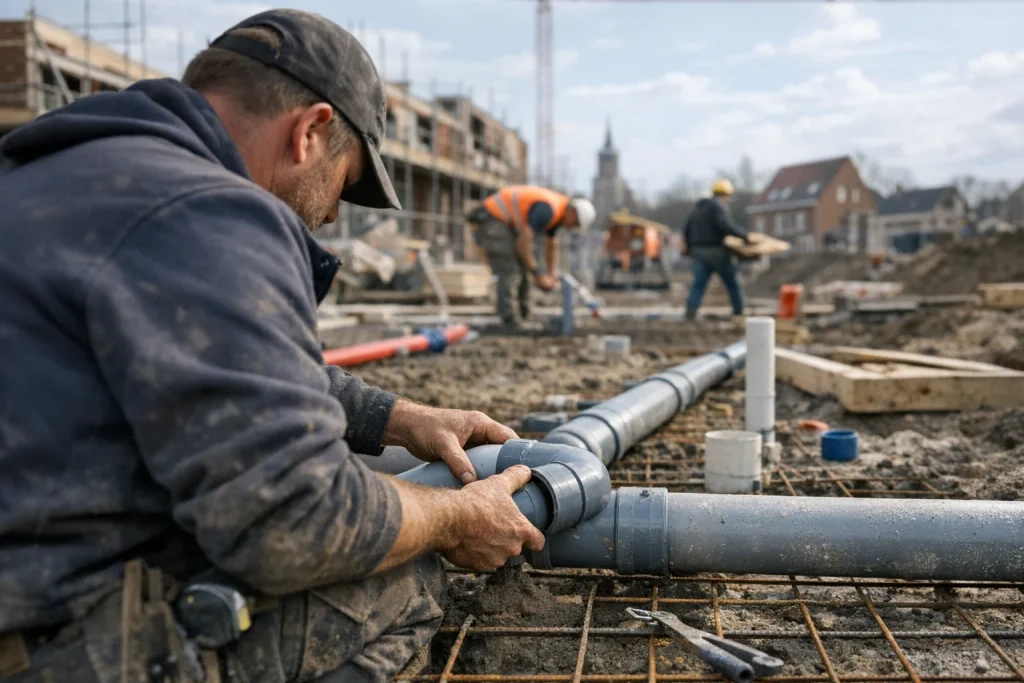
Direct answer
Foreign plumbers from the EU, EEA, or Switzerland can work in Groningen’s housing construction sector without a work permit due to freedom of movement. Non-EU plumbers must obtain a valid Dutch work and residence permit before starting employment. Jobs involve installing, repairing, and maintaining plumbing systems in new builds, renovations, and social housing projects. Pay is generally competitive compared to many European countries but varies by experience, CAO agreements, contract type, and region. Basic Dutch language skills and VCA safety certification are important for effective communication and safety on site. Housing arrangements depend on the employer or agency; with Haldu Groep, housing is typically well arranged, often including a private bedroom for the worker. Groningen’s compact city and strong cycling culture make commuting easy. Working conditions follow CAO Bouw & Infra and strict safety regulations.
Key points
- EU/EEA/Swiss plumbers do not require a work permit; non-EU plumbers must secure one before starting work.
- Housing construction projects in Groningen include new builds, renovations, and social housing.
- Pay depends on experience, CAO agreements, contract type, and region; Dutch construction pay is generally competitive.
- Basic Dutch language skills are recommended for safety and communication on site.
- VCA safety certification is often mandatory or preferred for plumbers on construction sites.
- Standard plumbing tools and personal protective equipment (PBM) are required on site.
- Housing for foreign plumbers varies; agencies like Haldu Groep typically arrange private bedrooms.
- Commuting in Groningen is usually by bike or public transport due to the city’s size and infrastructure.
- CAO Bouw & Infra governs wages, working hours, overtime, and holidays for plumbers.
- Training and certification pathways exist locally and nationally for plumbers.
- Employment contracts vary; always confirm pay, hours, and conditions in writing.
- Health and safety regulations are strictly enforced on Groningen construction sites.
Field expertise
Haldu Groep has specialized in placing skilled construction workers, including plumbers, in the Netherlands since 1999. The company understands the needs of foreign workers seeking employment in Dutch housing construction, especially in Groningen. The region’s construction sector focuses on sustainable housing, social housing, and renovations, requiring plumbers with strong technical skills and safety awareness. Dutch collective labor agreements (CAOs) like CAO Bouw & Infra set standards for wages and working conditions. VCA certification ensures compliance with safety regulations. Haldu Groep also assists with housing arrangements, often providing private bedrooms, which supports comfort and stability for foreign plumbers during their employment.
What should you know about housing construction plumber jobs in Groningen: guide for foreign workers?
Housing construction plumber jobs in Groningen involve installing, repairing, and maintaining plumbing systems in residential buildings. Projects include new housing developments, renovations of older homes, and social housing initiatives managed by municipalities. Groningen’s construction market is active due to urban growth and sustainability goals. Foreign plumbers must understand local labor laws, work permit requirements, and safety standards. EU/EEA/Swiss citizens benefit from freedom of movement and can start work without a permit, while non-EU plumbers require a valid work and residence permit. Basic Dutch language skills improve communication and safety on site. VCA certification is often mandatory or highly recommended. Housing arrangements vary; some employers or agencies provide accommodation, often with private bedrooms, easing the transition for foreign workers.
How does housing construction plumber jobs in Groningen: guide for foreign workers work in practice?
In practice, foreign plumbers applying for housing construction jobs in Groningen typically follow these steps: confirm eligibility to work (work permit if needed), prepare a CV tailored to Dutch employers, obtain necessary certifications like VCA, and secure housing. Many agencies, including Haldu Groep, assist with job placement and housing. Daily work involves installing pipes, fittings, and water systems using standard tools such as pipe wrenches, cutters, and power drills. Personal protective equipment (PBM) like helmets, gloves, and safety boots is mandatory. Work hours and contracts depend on the employer and CAO agreements. Commuting is often by bike or public transport, as Groningen is bike-friendly and compact. Safety checks and adherence to health regulations are routine on site.
Which conditions apply for housing construction plumber jobs in Groningen: guide for foreign workers?
Conditions for plumbers in Groningen’s housing construction sector include compliance with Dutch labor laws and CAO Bouw & Infra, which regulate wages, working hours, overtime, and holidays. Employment contracts may be fixed-term or permanent. Pay depends on experience, role, and CAO scales. VCA safety certification is often required. Workers must use standard tools and PBM for safety. Language skills, at least basic Dutch, are recommended to understand instructions and safety protocols. Housing conditions vary; some employers or agencies provide accommodation, typically private bedrooms, while others expect workers to arrange their own housing. Health and safety regulations are strictly enforced on construction sites.
Which mistakes are common around housing construction plumber jobs in Groningen: guide for foreign workers?
Common mistakes include:
- Starting work without the correct work permit (for non-EU plumbers).
- Underestimating the importance of Dutch language skills for safety and communication.
- Not obtaining VCA certification before applying for jobs.
- Failing to clarify contract terms, working hours, and pay before starting.
- Assuming housing will always be provided without confirmation.
- Ignoring health and safety rules on site, risking accidents or dismissal.
- Not tailoring the CV to Dutch employers, reducing job chances.
- Overlooking commuting options and travel time to project sites.
How do you proceed step by step?
- Check your eligibility to work in the Netherlands (EU/EEA/Swiss or non-EU).
- Obtain necessary work and residence permits if non-EU.
- Get VCA certification and any relevant plumbing qualifications.
- Prepare a Dutch-style CV highlighting your skills and experience.
- Apply for housing construction plumber jobs in Groningen through agencies or employers.
- Confirm contract details, pay, working hours, and housing arrangements.
- Arrange travel and commuting plans based on project locations.
- Start work, follow health and safety rules, and maintain communication on site.
What should you check before you start?
Before starting a plumbing job in Groningen housing construction, verify:
- Your work permit and residence status if non-EU.
- VCA certification validity and any other required qualifications.
- Contract type, pay scale, working hours, and overtime rules under CAO.
- Housing arrangements: confirm if accommodation is provided and its conditions.
- Required tools and personal protective equipment (PBM) to bring or expect.
- Language expectations and communication methods on site.
- Health and safety protocols specific to the employer or site.
- Commuting options and travel time to the worksite.
What does this look like in practice?
In practice, a foreign plumber working in Groningen’s housing construction sector will typically:
- Arrive with a valid work permit if non-EU or simply register if from EU/EEA/Switzerland.
- Receive a contract aligned with CAO Bouw & Infra, specifying pay and hours.
- Use standard plumbing tools such as pipe wrenches, cutters, and drills daily.
- Wear personal protective equipment like helmets, gloves, boots, and high-visibility vests.
- Communicate in basic Dutch or English with colleagues and supervisors.
- Live in employer-arranged housing, often a private bedroom, or find own accommodation.
- Commute by bike or public transport within Groningen’s well-connected network.
- Follow strict safety and health regulations, including site-specific rules.
| Aspect | EU/EEA/Swiss Plumbers | Non-EU Plumbers |
|---|---|---|
| Work Permit | Not required | Required before starting |
| Residence Permit | Not required | Required |
| VCA Certification | Usually required | Usually required |
| Housing | Often arranged by employer/agency | Often arranged by employer/agency |
| Language Skills | Basic Dutch recommended | Basic Dutch recommended |
| Project Type | Description | Typical Plumbing Tasks |
|---|---|---|
| New Housing Builds | Construction of new residential homes and apartments | Pipe installation, water system fitting, leak testing |
| Renovations | Updating and repairing existing housing stock | Replacing pipes, fixing leaks, upgrading installations |
| Social Housing | Affordable housing projects managed by municipalities | Installation and maintenance of plumbing systems |
| Tool or PBM | Purpose | Required on Site? |
|---|---|---|
| Pipe Wrench | Gripping and turning pipes | Yes |
| Pipe Cutter | Cutting pipes to length | Yes |
| Safety Helmet | Head protection | Yes |
| Safety Boots | Foot protection | Yes |
| Work Gloves | Hand protection | Yes |
Frequently asked questions
Do EU plumbers need a work permit to work in Groningen?
What permits do non-EU plumbers need?
Is VCA certification mandatory for plumbers in Groningen?
What types of housing construction projects are common in Groningen?
How is housing arranged for foreign plumbers?
What language skills are needed to work as a plumber in Groningen?
How does pay for plumbers in Groningen compare to other regions?
What tools and protective equipment do plumbers use on Groningen sites?
What are typical working hours for plumbers in Groningen?
How do plumbers commute to work in Groningen?
Conclusion
Foreign plumbers interested in housing construction jobs in Groningen should first verify their work permit status, especially if non-EU. Obtaining VCA certification and basic Dutch language skills improves safety and employability. Pay and working conditions follow CAO Bouw & Infra, offering competitive wages. Housing depends on the employer or agency, with Haldu Groep often providing well-arranged private rooms. Groningen’s compact layout supports commuting by bike or public transport. Preparing a tailored CV and understanding contract terms are essential. Following health and safety regulations ensures a safe and successful experience in Groningen’s growing housing construction sector.
