Direct answer
TIG welder jobs in Rotterdam are accessible to foreign workers, with eligibility depending on nationality and legal work status. Citizens from the EU/EEA and Switzerland can work without permits, while non-EU welders must obtain Dutch work and residence permits before employment. Employers require recognized welding certifications such as ISO 9606-1 and safety training like VCA. Pay is competitive and influenced by experience, contract type, and collective labor agreements (CAO). Housing arrangements depend on the placement or agency; with Haldu Groep, housing is typically well arranged, often including a private bedroom near worksites. Basic Dutch or English language skills are recommended for effective communication and safety. Rotterdam’s large port and industrial sectors provide diverse TIG welding opportunities in shipbuilding, infrastructure, and fabrication, supported by good public transport and cycling options.
Key points
- EU/EEA/Swiss welders do not need work permits; non-EU welders require valid permits before starting.
- ISO 9606-1 welding certification and VCA safety training are commonly required by employers.
- Pay depends on experience, CAO agreements (Metalektro, Bouw & Infra), contract type, and role.
- Housing arrangements vary by agency; with Haldu Groep, housing is typically well arranged, usually with private bedrooms in shared accommodation.
- Basic Dutch or English language skills improve workplace communication and safety compliance.
- Safety standards and PPE use are strictly enforced on Dutch construction and industrial sites.
- Rotterdam’s welding jobs focus on shipbuilding, port infrastructure, industrial fabrication, and maintenance.
- Public transport and cycling infrastructure facilitate easy commuting within Rotterdam.
- Haldu Groep has placed foreign welders in Rotterdam since 1999, assisting with permits and housing.
- Preparing a CV tailored to Dutch welding jobs increases chances of employment.
- Typical contracts range from temporary to permanent with regulated working hours and benefits.
- Understanding Dutch labor law and CAO agreements is essential for fair employment conditions.
Field expertise
Since 1999, Haldu Groep has specialized in placing skilled technical workers, including TIG welders, in Rotterdam and across the Netherlands. The company understands Dutch labor laws, CAO agreements, and safety requirements such as VCA certification. Haldu Groep supports foreign welders by facilitating legal work permits, arranging housing, and helping with integration into Dutch work culture. Rotterdam’s market demands TIG welders for projects in shipbuilding, port infrastructure, and industrial fabrication, where welders must meet strict quality and safety standards. Fluency in Dutch or English, proper certification, and compliance with labor contracts are key factors for success in this competitive environment.
What should you know about tig welder jobs in rotterdam: guide for foreign workers?
Foreign TIG welders aiming to work in Rotterdam should understand the legal, professional, and practical aspects of the job market. Work rights differ by nationality: EU/EEA/Swiss citizens can work without permits, while non-EU welders must secure Dutch work and residence permits. Employers require recognized welding certifications such as ISO 9606-1 or EN 287, and safety certifications like VCA (Veiligheid, Gezondheid en Milieu Checklist Aannemers). Pay is regulated by collective labor agreements (CAOs) such as Metalektro or Bouw & Infra, which set minimum wages and working conditions. Rotterdam’s welding jobs mainly involve shipbuilding, port maintenance, and industrial fabrication, reflecting the city’s major harbor and industrial base. Language skills and cultural adaptation are important for effective communication and safety on Dutch sites.
How does tig welder jobs in rotterdam: guide for foreign workers work in practice?
In practice, foreign TIG welders apply for jobs through recruitment agencies or directly with employers. EU/EEA/Swiss welders can start work immediately, while non-EU welders must obtain a valid work permit, often facilitated by the employer or agency. Employers verify welding qualifications and safety training before hiring. Contracts comply with Dutch CAO agreements, specifying pay, working hours, and benefits. Housing arrangements vary; agencies like Haldu Groep often provide or arrange accommodation with private bedrooms near Rotterdam or the worksite. Daily work involves TIG welding stainless steel, aluminum, or carbon steel on projects such as ship repairs, infrastructure welding, or industrial fabrication. Communication in Dutch or English is essential for safety and teamwork.
Which conditions apply for tig welder jobs in rotterdam: guide for foreign workers?
Conditions for TIG welder jobs in Rotterdam include legal authorization to work, valid welding certifications, and adherence to Dutch labor laws. EU/EEA/Swiss welders do not require permits; non-EU welders must have a valid work and residence permit. Employers expect welders to hold recognized certificates such as ISO 9606-1 or EN 287, and often VCA safety certification. Contracts follow CAO agreements, ensuring fair wages, regulated working hours, and benefits. Safety is a priority: welders must wear PPE including welding helmets, fire-resistant gloves, and safety boots. Language skills in Dutch or English are recommended to understand instructions and safety protocols. Housing arrangements depend on the employer or agency; with Haldu Groep, housing is typically well arranged, often providing private rooms.
Which mistakes are common around tig welder jobs in rotterdam: guide for foreign workers?
Common mistakes foreign TIG welders make include:
- Starting work without the proper legal permits if non-EU.
- Applying without recognized welding certifications or VCA safety training.
- Underestimating the importance of language skills for safety and communication.
- Failing to tailor the CV to Dutch standards and welding job requirements.
- Not confirming contract details such as pay, working hours, and housing before starting.
- Ignoring Dutch safety rules and PPE requirements on site.
- Assuming housing must always be self-arranged; many agencies provide or assist with housing.
- Not researching typical projects and employer expectations in Rotterdam’s welding sector.
How do you proceed step by step?
- Determine your citizenship status: EU/EEA/Swiss or non-EU.
- If non-EU, apply for and obtain the necessary Dutch work and residence permits.
- Verify and obtain required welding certifications such as ISO 9606-1 and VCA.
- Prepare a CV emphasizing welding experience, certifications, and safety training.
- Apply for TIG welder jobs via recruitment agencies like Haldu Groep or directly with employers.
- Confirm contract terms including pay, working hours, and housing arrangements.
- Arrange travel and accommodation; agencies often assist with housing.
- Improve Dutch or English language skills if needed for communication and safety.
- Start work with proper PPE and follow all safety protocols.
- Consider career development options after gaining local experience.
What should you check before you start?
Before starting a TIG welder job in Rotterdam, check the following:
- Your legal work status and valid permits.
- Recognition and validity of welding and safety certificates.
- Contract details: pay scale, working hours, overtime rules, and benefits.
- Housing arrangements: location, privacy, and costs if applicable.
- Language requirements and communication expectations on site.
- Availability and condition of personal protective equipment (PPE).
- Project type and employer reputation.
- Commuting options and travel time to the worksite.
- Health and safety training or site-specific induction requirements.
What does this look like in practice?
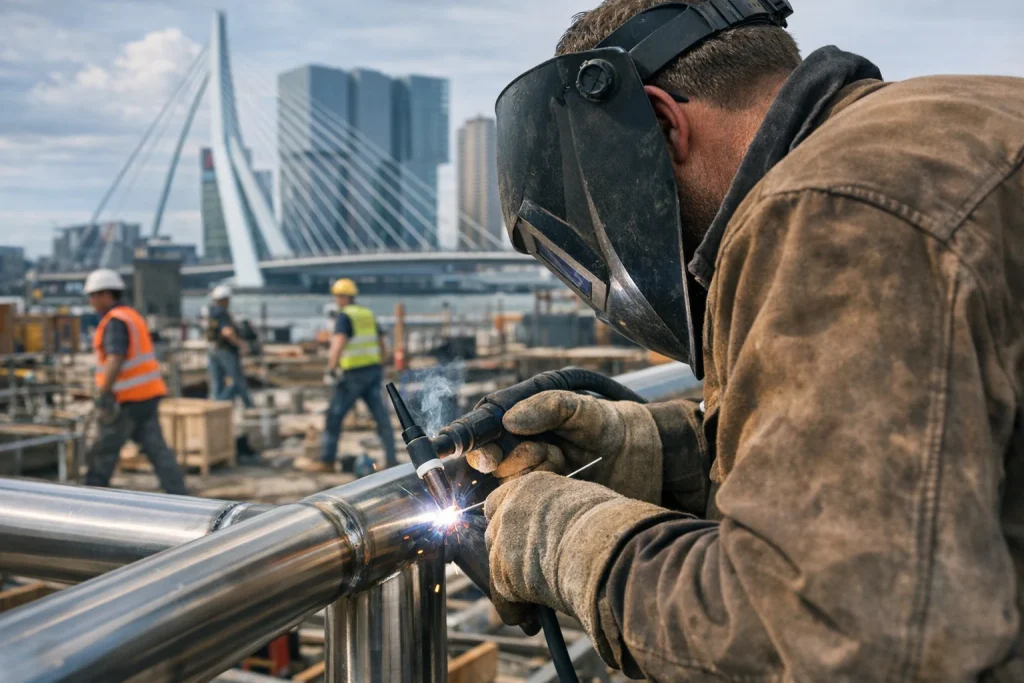
In practice, a foreign TIG welder arrives in Rotterdam with a valid work permit (if required), proper certificates, and a CV tailored to Dutch employers. Upon hiring, the welder receives a contract aligned with CAO standards, ensuring fair pay and regulated working hours. Housing is often arranged by the agency, providing a private bedroom in shared accommodation near Rotterdam or the worksite. Daily tasks include TIG welding on ship hulls, steel structures, or industrial equipment, using stainless steel or aluminum. Welders wear PPE such as helmets, gloves, and boots, and communicate in Dutch or English with colleagues. Public transport or cycling is common for commuting. Safety training and VCA certification are regularly updated to meet Dutch regulations.
| Aspect | EU/EEA/Swiss Welders | Non-EU Welders |
|---|---|---|
| Work Permit | Not required | Required before starting work |
| Residence Permit | Not required | Required |
| Certification | ISO 9606-1, VCA preferred | ISO 9606-1, VCA mandatory |
| Housing | Often arranged by agency | Often arranged by agency |
| Language | Dutch or English recommended | Dutch or English recommended |
| Certification | Description | Importance |
|---|---|---|
| ISO 9606-1 | Welder qualification for TIG welding | High – often required by employers |
| VCA | Safety certification for contractors | Critical for site access and safety compliance |
| EN 287 | European welding qualification standard | Preferred or equivalent to ISO 9606-1 |
| NEN 3140 | Electrical safety standard (sometimes relevant) | Recommended for welding technicians |
| Project Type | Typical Materials | Common Welding Tasks |
|---|---|---|
| Shipbuilding & Repair | Stainless steel, aluminum, carbon steel | Hull welding, pipe welding, structural welding |
| Infrastructure & Construction | Carbon steel, structural steel | Bridge welding, steel frame fabrication |
| Industrial Fabrication | Stainless steel, aluminum | Equipment welding, pressure vessels |
Frequently asked questions
Do EU citizens need a work permit to weld in Rotterdam?
What certifications do I need for TIG welding jobs in Rotterdam?
Can non-EU welders work in Rotterdam?
How much do TIG welders earn in Rotterdam?
Is housing provided for foreign welders in Rotterdam?
Do I need to speak Dutch to work as a TIG welder?
What PPE is standard for TIG welders in Rotterdam?
What types of projects employ TIG welders in Rotterdam?
How do I prepare my CV for TIG welder jobs in Rotterdam?
Are there career advancement opportunities for TIG welders in Rotterdam?
Conclusion
Foreign TIG welders have solid opportunities in Rotterdam if they meet legal work requirements and hold recognized certifications like ISO 9606-1 and VCA. EU/EEA/Swiss welders benefit from easier access, while non-EU welders must secure permits before starting. Pay is competitive and regulated by CAO agreements, with housing arrangements depending on the agency; with Haldu Groep, housing is typically well arranged and includes private rooms. Language skills and strict safety compliance are essential for success. Preparing a tailored CV and understanding Dutch labor conditions improve employment chances. Rotterdam’s diverse welding projects and strong transport infrastructure make it an attractive city for skilled TIG welders seeking work in the Netherlands.