
Direct answer
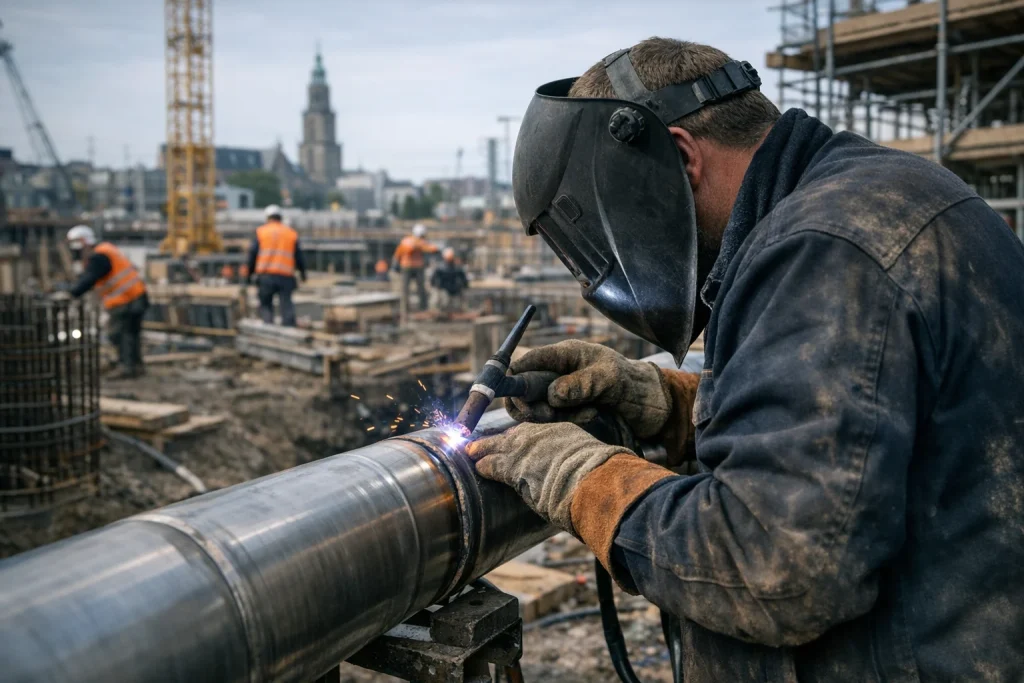
TIG welder jobs in Groningen are accessible to foreign workers, with EU, EEA, and Swiss nationals able to work without a permit. Non-EU citizens must obtain a Dutch work and residence permit before starting employment. Pay is competitive within the Dutch industrial and construction sectors, influenced by experience, contract type, and collective labor agreements (CAOs). Housing is often arranged by employers or agencies, usually including private bedrooms, especially through agencies like Haldu Groep. Basic English is generally sufficient on site, but learning Dutch improves safety and communication. Common projects include shipbuilding, industrial maintenance, and infrastructure. Strict safety regulations require personal protective equipment (PPE) such as welding helmets, gloves, and protective clothing.
Key points
- EU/EEA/Swiss citizens do not need work permits; non-EU welders must secure permits before working.
- Pay depends on experience, CAO agreements, contract type, and project complexity.
- Common projects include shipbuilding, industrial maintenance, chemical plants, and infrastructure.
- Housing is often provided or arranged by employers or agencies; private rooms are common.
- ISO 9606-1 welding certification and VCA safety certification are essential or highly preferred.
- Basic English is usually sufficient; Dutch language skills improve safety and teamwork.
- Mandatory PPE includes welding helmets, gloves, fire-resistant clothing, and safety boots.
- Groningen offers good public transport and bike-friendly commuting options.
- Collective labor agreements regulate wages, working hours, and conditions.
- Recruitment agencies support foreign welders with permits, housing, and integration.
- Work schedules typically involve 40-hour weeks with possible overtime or shifts.
- Understanding Dutch labor laws and safety standards is crucial for compliance.
Field expertise
Since 1999, Haldu Groep has specialized in placing skilled technical workers, including TIG welders, across the Netherlands. Their expertise covers recruitment, housing arrangements, and ensuring compliance with Dutch labor laws and safety standards. TIG welding in Groningen often involves projects in shipbuilding, industrial maintenance, and infrastructure, requiring precise welding skills and certifications such as ISO 9606-1 and VCA. The Dutch labor market is regulated by collective labor agreements that guarantee fair pay and working conditions. Foreign workers benefit from agencies that assist with legal paperwork, certification recognition, and workplace integration.
What should you know about tig welder jobs in groningen: guide for foreign workers?
Foreign TIG welders should understand that Groningen’s welding market focuses on industrial, maritime, and infrastructure projects. EU/EEA/Swiss citizens can work freely, while non-EU welders must secure appropriate work and residence permits. Employers prioritize recognized welding certifications and safety training. Housing varies by employer or agency, with many offering well-arranged accommodation including private bedrooms. Language skills matter: English is often used on site, but basic Dutch improves communication and safety compliance. Dutch health and safety laws require strict use of PPE. Groningen’s economy supports steady demand for TIG welders, especially in shipbuilding and chemical sectors.
How does tig welder jobs in groningen: guide for foreign workers work in practice?
Foreign TIG welders typically apply through recruitment agencies or directly to employers in Groningen. Agencies like Haldu Groep assist with CV preparation, work permits, and housing arrangements. After hiring, welders attend safety briefings and may receive additional training. Work involves TIG welding stainless steel, aluminum, and carbon steel on industrial or maritime projects. Shifts vary from standard daytime hours to rotating shifts depending on the project. Welders must follow strict safety protocols, including wearing welding helmets, gloves, and fire-resistant clothing. Communication is mostly in English, with Dutch increasingly used on site.
Which conditions apply for tig welder jobs in groningen: guide for foreign workers?
TIG welder jobs in Groningen are governed by Dutch labor law and collective labor agreements (CAOs) such as the Construction CAO or Metalworking CAO. These agreements set minimum wages, working hours, overtime rules, and holiday entitlements. EU/EEA/Swiss citizens have unrestricted work rights; non-EU welders require work and residence permits. Employers must provide a safe working environment, including mandatory PPE. Contracts can be temporary or permanent, with pay reflecting experience and certification level. Health and safety training, including VCA certification, is often mandatory.
Which mistakes are common around tig welder jobs in groningen: guide for foreign workers?
- Failing to verify work permit requirements before applying (especially for non-EU workers).
- Submitting CVs without emphasizing welding certifications like ISO 9606-1 or VCA.
- Underestimating the importance of basic Dutch language skills for safety and communication.
- Not confirming housing arrangements before arrival, leading to accommodation difficulties.
- Ignoring collective labor agreements, causing misunderstandings about pay and hours.
- Not preparing for the physical demands and safety protocols of TIG welding.
- Overlooking the need for valid PPE and safety training compliance.
How do you proceed step by step?
- Check your nationality and work permit requirements for the Netherlands.
- Obtain or update TIG welding certifications (ISO 9606-1, VCA).
- Prepare a CV tailored to Dutch welding jobs, highlighting skills and certifications.
- Contact recruitment agencies like Haldu Groep or apply directly to Groningen employers.
- Clarify housing options and costs before accepting a job offer.
- Arrange travel and accommodation logistics for Groningen.
- Prepare for health and safety training and ensure access to proper PPE.
- Start work, follow safety rules, and consider learning basic Dutch for better integration.
What should you check before you start?
- Your work permit status (if non-EU).
- Validity and recognition of your welding certifications.
- Employment contract details: pay, hours, CAO coverage.
- Housing arrangements and living costs in Groningen.
- Health and safety training requirements and PPE provision.
- Transport options for commuting if not living on-site.
- Language expectations on the job site.
- Contact details of your employer or agency for support.
What does this look like in practice?
A foreign TIG welder arriving in Groningen typically starts with an agency interview, document verification, and contract signing. Housing is often arranged by the agency or employer, usually a shared apartment with private bedrooms. The welder attends a safety induction, receives PPE, and begins work on projects such as ship repair or industrial pipe welding. Work schedules usually involve 40-hour weeks, with possible overtime. Communication is mostly in English, with Dutch used for safety signs and some instructions. Many welders commute by bike or public transport from nearby towns.
| Aspect | Groningen | Amsterdam | Rotterdam |
|---|---|---|---|
| Average TIG Welder Pay | Depends on experience / CAO; competitive within Dutch construction | Depends on experience / CAO; higher cost of living reflected | Depends on experience / CAO; similar to Groningen, port-related jobs |
| Housing Availability | Often provided by agencies; private rooms common | More expensive, less agency housing | Agency housing available, varies by employer |
| Common Projects | Shipbuilding, industrial maintenance, infrastructure | High-tech construction, infrastructure | Port industry, ship repair, heavy industry |
| Commute Options | Good public transport, bike-friendly | Extensive public transport | Public transport and bike options |
| Certification | Purpose | Required/Preferred |
|---|---|---|
| ISO 9606-1 | Welder qualification for TIG welding | Required |
| VCA | Safety certification for working on Dutch sites | Highly preferred |
| NEN 3140 | Electrical safety for technical workers | Preferred for some roles |
| Work Permit Type | EU/EEA/Swiss | Non-EU |
|---|---|---|
| Requirement | No permit needed | Work permit and residence permit required |
| Application Process | None | Employer applies with UWV and IND |
| Processing Time | Immediate | Several weeks to months |
Frequently asked questions
Do I need a work permit to work as a TIG welder in Groningen?
What certifications are required for TIG welding jobs in Groningen?
How much can I expect to earn as a TIG welder in Groningen?
Is housing provided for foreign TIG welders in Groningen?
Are Dutch language skills necessary for TIG welding jobs?
What personal protective equipment is mandatory for TIG welders?
What types of projects employ TIG welders in Groningen?
How long are typical working hours for TIG welders?
Can I commute to Groningen from nearby towns?
What role do recruitment agencies play for foreign TIG welders?
Conclusion
Foreign TIG welders aiming to work in Groningen should first confirm their work permit status and secure recognized welding and safety certifications. Housing is often arranged by agencies or employers, typically including private bedrooms. Understanding Dutch labor laws, collective agreements, and safety requirements is essential for a smooth start. Basic English suffices on site, but learning Dutch enhances communication and safety. Groningen’s industrial and maritime sectors offer steady TIG welding work with competitive pay and good commuting options. Recruitment agencies like Haldu Groep provide valuable support for foreign welders entering this market. Planning ahead and preparing documentation will help ensure a successful transition to working life in Groningen.
