
Direct answer
MIG/MAG welder jobs in Utrecht are accessible to foreign workers who meet legal requirements and hold recognized welding certifications. EU/EEA/Swiss nationals can work without a permit, while non-EU welders must obtain a Dutch work permit, usually arranged by the employer or staffing agency. Pay depends on experience, contract type, and collective labor agreements (CAOs), with Utrecht offering competitive wages compared to other Dutch cities. Housing is often provided or arranged by employers or agencies; Haldu Groep typically offers well-organized housing with private rooms. Basic Dutch or English language skills and safety certifications such as VCA improve job prospects and workplace safety. Utrecht’s central location supports diverse welding projects and convenient commuting, making it a practical choice for foreign MIG/MAG welders.
Key points
- EU/EEA/Swiss welders have unrestricted work rights; non-EU welders require a Dutch work permit.
- MIG/MAG welding certificates (ISO 9606, EN 287) and VCA safety certification are often mandatory.
- Pay varies by experience, CAO agreements, contract type, and project complexity.
- Common projects include construction, infrastructure, metal fabrication, and industrial maintenance.
- Basic Dutch or English language skills are important for communication and safety.
- Working hours follow Dutch labor laws, typically around 40 hours per week with regulated overtime.
- Housing arrangements depend on employer or agency; private rooms in shared housing are common.
- Utrecht’s central location offers access to diverse projects and good public transport connections.
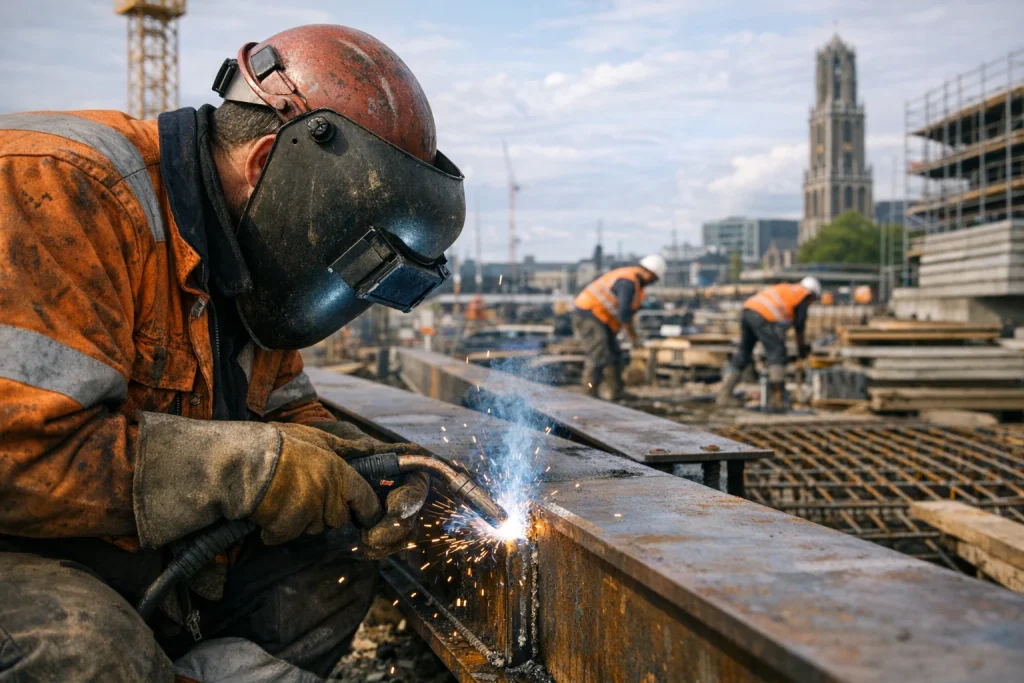
- Strict PPE standards apply, including helmets, gloves, protective clothing, and safety boots.
- Apprenticeships and training programs are available for welders seeking career advancement.
- Dutch labor laws protect foreign welders’ rights, including fair pay and safe working conditions.
- Cost of living in Utrecht is moderate compared to Amsterdam but requires budgeting for housing and transport.
Field expertise
Since 1999, Haldu Groep has specialized in placing skilled workers, including MIG/MAG welders, in the Dutch construction and metal industries. The company understands the legal frameworks, certification requirements, and labor market conditions foreign welders face in Utrecht and the Netherlands. Haldu Groep collaborates with employers to ensure compliance with Dutch labor laws, safety standards, and collective labor agreements (CAOs) such as CAO Metalektro and CAO Bouw & Infra. Their experience includes arranging housing solutions tailored to foreign workers’ needs, often providing private rooms in well-maintained shared accommodations. This expertise supports welders in navigating work permits, certifications like VCA, and adapting to local workplace culture.
What should you know about mig/mag welder jobs in utrecht: guide for foreign workers?
MIG/MAG welding jobs in Utrecht cover sectors such as construction, infrastructure, metal fabrication, and industrial maintenance. Foreign welders must understand legal work requirements based on nationality. EU/EEA/Swiss nationals can work freely without permits, while non-EU welders need a valid Dutch work permit, typically arranged by the employer or agency. Welding certifications such as MIG/MAG certificates (ISO 9606, EN 287) and safety certificates like VCA are essential to qualify. Language skills in Dutch or English improve safety communication and integration on site. Utrecht’s central location makes it a hub for varied welding projects involving steel, stainless steel, and aluminum materials.
How does mig/mag welder jobs in utrecht: guide for foreign workers work in practice?
Foreign MIG/MAG welders in Utrecht usually apply through staffing agencies or directly with employers. Once hired, they receive contracts regulated by Dutch labor laws, often under CAO agreements that define pay scales and working conditions. Welders work on construction sites, industrial plants, or fabrication workshops. Daily tasks include preparing weld seams, setting welding parameters, and operating MIG/MAG welding machines safely with proper PPE. Safety training and VCA certification are often prerequisites. Working hours follow the Dutch Arbeidstijdenwet, with shifts and overtime regulated. Housing may be arranged by the employer or agency, with Haldu Groep known for providing private rooms in shared housing. Commuting is convenient via Utrecht’s extensive public transport and road network.
Which conditions apply for mig/mag welder jobs in utrecht: guide for foreign workers?
Conditions for MIG/MAG welders in Utrecht include:
- Work permits: Required for non-EU welders; EU/EEA/Swiss nationals are exempt.
- Certifications: MIG/MAG welding certificates (ISO 9606, EN 287) and VCA safety certification.
- Contracts: Temporary, fixed-term, or permanent contracts under CAOs like Metalektro or Bouw & Infra.
- Pay: Depends on experience, CAO, and contract type; competitive compared to other Dutch cities.
- Working hours: Regulated by Dutch labor law, typically 40 hours/week with overtime rules.
- Safety: Use of PPE including welding helmets, gloves, protective clothing, and safety boots is mandatory.
- Language: Basic Dutch or English recommended for safety and communication.
- Housing: Often arranged by employer or agency; private rooms common.
Which mistakes are common around mig/mag welder jobs in utrecht: guide for foreign workers?
Common mistakes foreign welders make include:
- Starting work without proper work permits or legal documentation.
- Underestimating the importance of VCA safety certification for site access.
- Failing to verify contract terms, pay rates, and working hours before starting.
- Ignoring language requirements, leading to communication and safety issues.
- Not arranging housing early or assuming it will always be provided.
- Overlooking Dutch labor laws protecting worker rights and benefits.
- Neglecting to use required personal protective equipment (PPE) on site.
- Not understanding local commuting options and travel times.
How do you proceed step by step?
- Check your nationality status: EU/EEA/Swiss or non-EU.
- For non-EU: apply for a Dutch work permit through your employer or agency.
- Obtain required welding certifications (MIG/MAG welding certificates, VCA safety).
- Prepare a clear CV highlighting welding experience and certifications.
- Apply for jobs via agencies like Haldu Groep or directly with employers in Utrecht.
- Review and sign your employment contract carefully, confirming pay and conditions.
- Arrange housing early; confirm if your agency or employer provides accommodation.
- Plan your commute using Utrecht’s public transport or local roads.
- Attend any required safety or language training before starting work.
- Follow all safety protocols and use PPE at all times on site.
What should you check before you start?
Before starting a MIG/MAG welder job in Utrecht, verify:
- Your legal right to work (work permit if non-EU).
- Validity of your welding and safety certifications.
- Details of your employment contract: pay, hours, duration, and benefits.
- Housing arrangements and costs if accommodation is provided.
- Language requirements and availability of support if needed.
- Workplace safety rules and PPE requirements.
- Commuting options and travel times to the worksite.
- Contact information for your employer or agency in case of issues.
What does this look like in practice?
In practice, a foreign MIG/MAG welder arriving in Utrecht will:
- Present their work permit and certifications to the employer.
- Receive an employment contract detailing pay and working hours under Dutch labor law.
- Attend a safety briefing and possibly a VCA refresher course.
- Be provided with or arrange personal protective equipment (helmet, gloves, boots).
- Move into agency-arranged housing, often a private room in a shared apartment.
- Commute daily via Utrecht’s public transport or car, with travel times typically under one hour.
- Work on diverse projects such as building construction, infrastructure welding, or metal fabrication.
- Communicate in Dutch or English with supervisors and colleagues to ensure safety and quality.
- Receive monthly pay according to CAO agreements and contract terms.
| Aspect | Details | Notes |
|---|---|---|
| Work Permit | Required for non-EU welders | EU/EEA/Swiss nationals exempt |
| Certifications | MIG/MAG welding certificate, VCA safety | ISO 9606, EN 287 recognized |
| Pay | Depends on experience / CAO / contract | Often higher than many other European countries, with regional and role variations |
| Housing | Often agency-provided, private rooms common | Haldu Groep known for good housing arrangements |
| Language | Dutch or English recommended | Improves safety and integration |
| Common Projects | Materials | Typical Welding Tasks |
|---|---|---|
| Building construction | Steel, stainless steel | Weld seams, set parameters, inspect weld beads |
| Infrastructure (bridges, tunnels) | Metal alloys, steel | Site welding, safety checks, documentation |
| Industrial maintenance | Aluminum, steel | Repair welds, metal fabrication, quality control |
| Contract Type | Typical Duration | Notes |
|---|---|---|
| Temporary | Weeks to months | Often via agencies, flexible; pay depends on experience and CAO |
| Fixed-term | Several months to 1 year | Project-based, with benefits; pay depends on experience and CAO |
| Permanent | Indefinite | Full benefits, career growth; pay depends on experience and CAO |
Frequently asked questions
Do I need a work permit to work as a MIG/MAG welder in Utrecht?
What welding certifications are required for MIG/MAG welders in Utrecht?
How much can I expect to earn as a MIG/MAG welder in Utrecht?
Is housing provided for foreign welders in Utrecht?
How important is Dutch language for welders in Utrecht?
What are the typical working hours for welders in Utrecht?
Are there apprenticeship opportunities for foreign welders in Utrecht?
What personal protective equipment (PPE) is required?
How do Dutch labor laws protect foreign welders?
Can I commute daily to Utrecht from nearby towns?
Conclusion
Foreign workers seeking MIG/MAG welder jobs in Utrecht should secure the correct work permits, obtain recognized welding and safety certifications, and understand Dutch labor laws. Pay and contract conditions vary but are generally favorable within the Dutch construction sector. Housing is often arranged by agencies like Haldu Groep, offering practical accommodation options with private rooms. Basic Dutch or English language skills improve safety and communication on site. Utrecht’s central location provides access to diverse welding projects and manageable commuting. Careful preparation and knowledge of local conditions will help foreign welders succeed in Utrecht’s competitive labor market.
