
Direct answer
MIG/MAG welder jobs in Rotterdam are accessible to foreign workers, with work rights depending on nationality. EU, EEA, and Swiss nationals can work without a permit, while non-EU welders must obtain a valid work visa before employment. Recognized welding certificates such as ISO 9606-1 are essential to qualify. Pay varies by experience, contract type, and project complexity, and Dutch construction pay is often higher than in many other European countries due to CAO agreements, though living costs should be considered. Housing in Rotterdam can be expensive but is usually arranged by recruitment agencies like Haldu Groep, which typically provide well-organized accommodation including private rooms near industrial zones. Basic Dutch or English language skills improve workplace communication and safety. Welding jobs in Rotterdam are common in shipbuilding, construction, and industrial maintenance, with VCA certification often required for safety compliance.
Key points
- EU/EEA/Swiss nationals do not need a work permit; non-EU welders require a valid visa.
- Recognized welding certificates like ISO 9606-1 are mandatory for MIG/MAG welding jobs.
- Pay depends on experience, CAO agreements, contract type, and project complexity.
- Housing costs vary; agencies often provide private rooms and help with accommodation.
- Basic Dutch or English language skills are recommended for workplace communication and safety.
- Common industries hiring welders include shipbuilding, construction, and industrial maintenance.
- VCA safety certification is highly valued and often required on Rotterdam sites.
- Public transport and short commutes are typical for welders working in Rotterdam.
- Training and upskilling opportunities exist to improve welding techniques and certifications.
- Understanding Dutch labor laws and CAO agreements helps ensure fair working conditions.
- Proper personal protective equipment (PPE) is mandatory for safety compliance.
- Recruitment agencies assist with legal paperwork, housing, and integration.
Field expertise
Since 1999, Haldu Groep has specialized in placing skilled workers, including MIG/MAG welders, in the Rotterdam region. Rotterdam’s strategic port and industrial areas create steady demand for welders in shipbuilding, construction, and heavy industry. Welding jobs here require adherence to Dutch safety standards, including VCA certification, and recognized welding qualifications such as ISO 9606-1. Agencies like Haldu Groep support foreign welders with legal paperwork, housing arrangements—typically providing private bedrooms—and integration into the Dutch labor market. Dutch collective labor agreements (CAO) regulate pay, working hours, and benefits, ensuring fair conditions for welders.
What should you know about mig/mag welder jobs in rotterdam: guide for foreign workers?
MIG/MAG welding jobs in Rotterdam require specific skills, certifications, and legal permissions. EU/EEA/Swiss nationals can start working immediately without a permit, while non-EU welders must secure a work visa before employment. Employers prioritize welders with recognized certificates such as ISO 9606-1 or EN 287, proving their MIG/MAG welding competence. Pay rates are influenced by experience, type of contract (temporary or permanent), and the sector, with the Dutch construction CAO often setting minimum wages and benefits. Rotterdam’s housing market is competitive; agencies like Haldu Groep typically provide well-arranged housing with private bedrooms. Language skills in Dutch or English improve communication and safety on site. VCA certification is often mandatory, reflecting the city’s focus on workplace safety.
How does mig/mag welder jobs in rotterdam: guide for foreign workers work in practice?
In practice, foreign welders applying for MIG/MAG jobs in Rotterdam must first ensure they have the right to work legally. EU/EEA/Swiss nationals can start immediately, while non-EU welders must apply for a work visa, often sponsored by an employer or agency. Once legal, candidates submit their CV and welding certificates to recruitment agencies or employers. If hired, welders typically undergo a safety induction, including VCA training. Housing is arranged either by the agency or independently, with many welders living in shared apartments or private rooms close to Rotterdam’s industrial zones. Daily commutes usually involve public transport or bicycles, given Rotterdam’s compact urban area. Pay is paid monthly or weekly, depending on the contract and CAO rules.
Which conditions apply for mig/mag welder jobs in rotterdam: guide for foreign workers?
Conditions for MIG/MAG welding jobs in Rotterdam include legal work authorization, recognized welding certificates, and compliance with Dutch labor laws. EU/EEA/Swiss workers have free access, while non-EU welders need a valid work visa. Employers require proof of welding skills through certificates like ISO 9606-1 or equivalent. Safety standards demand VCA certification, personal protective equipment (PPE), and adherence to workplace rules. Contracts follow Dutch CAO agreements, which regulate wages, working hours, overtime, and holiday entitlements. Housing conditions vary but are often supported by agencies. Language skills, at least basic English or Dutch, are important for safety and team communication.
Which mistakes are common around mig/mag welder jobs in rotterdam: guide for foreign workers?
Common mistakes include starting work without proper legal authorization, lacking recognized welding certificates, and underestimating the importance of VCA safety certification. Some welders neglect language skills, which can cause misunderstandings and safety risks. Others fail to research housing options early, leading to high costs or poor living conditions. Misunderstanding Dutch CAO agreements can result in accepting unfair pay or working conditions. Finally, some welders overlook the need for proper PPE, risking injury and non-compliance with safety rules.
How do you proceed step by step?
- Confirm your nationality and legal work rights in the Netherlands.
- Obtain recognized MIG/MAG welding certificates (ISO 9606-1 or equivalent).
- Apply for a work visa if you are a non-EU/EEA/Swiss national.
- Prepare a clear CV highlighting welding experience and certifications.
- Contact recruitment agencies like Haldu Groep or employers directly.
- Complete VCA safety training and other required inductions.
- Arrange housing through the agency or independently, ideally before arrival.
- Start work under a contract aligned with Dutch CAO agreements.
- Use public transport or bike for commuting within Rotterdam.
- Consider further training or upskilling to improve career prospects.
What should you check before you start?
- Verify your legal right to work in the Netherlands.
- Confirm that your welding certificates are recognized by Dutch employers.
- Ensure you have or will obtain VCA certification for safety compliance.
- Understand the terms of your employment contract, including pay and working hours.
- Check housing arrangements and costs before relocating.
- Assess your language skills and consider basic Dutch or English courses.
- Prepare necessary personal protective equipment if not provided by the employer.
- Know the location of your workplace and commute options.
- Review Dutch labor laws and CAO agreements relevant to welders.
What does this look like in practice?
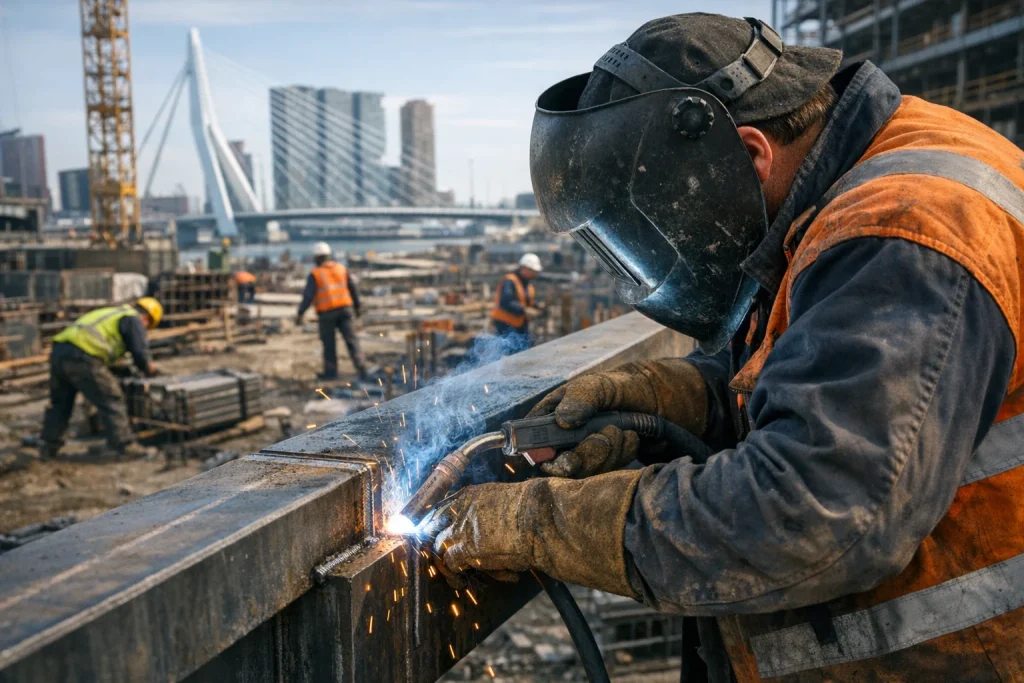
A foreign MIG/MAG welder arriving in Rotterdam typically starts by meeting with a recruitment agency or employer to verify documents and certificates. After signing a contract, the welder attends a VCA safety course, receives PPE such as welding helmets, gloves, and jackets, and gets a safety induction on site. Housing is often arranged by the agency, providing a private room in shared accommodation near the port or industrial areas. Daily work involves welding steel or metal alloys on shipyards, construction sites, or industrial plants. Pay is processed monthly, with deductions for taxes and social security. Communication is usually in English or basic Dutch, and public transport or biking is common for commuting.
| Aspect | EU/EEA/Swiss Workers | Non-EU Workers |
|---|---|---|
| Work Permit | Not required | Required (work visa) |
| Welding Certification | ISO 9606-1 or equivalent | ISO 9606-1 or equivalent |
| VCA Certification | Highly recommended/required | Highly recommended/required |
| Housing | Agency arranged or private | Agency arranged recommended |
| Language | Basic Dutch or English advised | Basic Dutch or English advised |
| Pay Influencing Factors | Details |
|---|---|
| Experience Level | Depends on experience and skill level |
| CAO Agreement | Sets minimum wages and benefits |
| Contract Type | Permanent contracts often offer better pay than temporary |
| Industry Sector | Shipbuilding and industrial maintenance sectors often pay higher |
| Project Complexity | More complex projects may include bonuses |
| Common PPE for MIG/MAG Welders | Purpose |
|---|---|
| Welding Helmet | Protects eyes and face from sparks and UV radiation |
| Welding Gloves | Protects hands from heat and sparks |
| Welding Jacket | Protects upper body from burns and sparks |
| Safety Boots | Protects feet from heavy objects and sparks |
| Respirator Mask | Protects lungs from fumes and dust (if required) |
Frequently asked questions
Do I need a work permit to work as a MIG/MAG welder in Rotterdam?
Which welding certificates are recognized for MIG/MAG welding jobs in Rotterdam?
Is VCA certification mandatory for welders in Rotterdam?
What is the typical pay range for MIG/MAG welders in Rotterdam?
How can I find housing as a foreign welder in Rotterdam?
Are language skills important for welders in Rotterdam?
What industries commonly hire MIG/MAG welders in Rotterdam?
How long is the typical commute for welders in Rotterdam?
Can non-EU welders get help with legal paperwork and housing?
What personal protective equipment must I use as a MIG/MAG welder?
Conclusion
Foreign welders aiming for MIG/MAG jobs in Rotterdam should ensure they have the correct legal status and recognized welding certificates. Obtaining VCA certification and basic language skills enhances safety and employability. Housing is often arranged by recruitment agencies but requires early planning due to Rotterdam’s competitive market. Understanding Dutch CAO agreements helps secure fair pay and working conditions. Rotterdam offers diverse opportunities in shipbuilding, construction, and industry, with short commutes and strong safety standards. Careful preparation, legal compliance, and proper documentation are key to a successful welding career in this dynamic city.
