
Direct answer
Construction jobs in Almere are accessible to foreign workers, with EU/EEA/Swiss nationals able to work without permits, while non-EU nationals must secure valid work and residence permits before employment. Almere’s growing construction sector offers diverse roles from general labor to skilled trades such as bricklayers, carpenters, electricians, and supervisors. Pay is competitive and regulated by collective labor agreements (CAO), varying by experience and role. Employers or agencies often arrange housing, typically providing private rooms. Basic Dutch or English language skills and safety certifications like VCA are usually required. Almere’s mix of residential, commercial, and infrastructure projects, combined with good transport links, makes it a practical location for foreign construction workers seeking stable jobs and career development.
Key points
- EU/EEA/Swiss nationals can work in Almere construction without permits; non-EU nationals need valid work and residence permits.
- High demand for skilled roles: bricklayers, carpenters, electricians, plumbers, laborers, and supervisors.
- VCA safety certification is commonly mandatory for construction site work.
- Pay depends on role, experience, and CAO agreements; generally competitive compared to many European countries.
- Housing is often provided or arranged by employers or agencies, usually including private bedrooms.
- Basic Dutch or English language skills improve safety and communication on site.
- Almere’s construction projects include residential neighborhoods, commercial buildings, and infrastructure upgrades.
- Good public transport and bike infrastructure facilitate commuting within Almere and to nearby cities.
- Apprenticeships and training programs support skill development and career progression.
- Contracts comply with Dutch labor law and CAO standards, ensuring fair working conditions.
- Personal protective equipment (PPE) is mandatory on all construction sites.
- Preparing a clear CV highlighting skills and certifications increases hiring chances.
Field expertise
Since 1999, Haldu Groep has specialized in placing foreign workers in Dutch construction roles, including in Almere. The company understands Dutch labor laws, CAO agreements, and the practical needs of foreign workers such as housing and safety certification. Almere’s construction sector is dynamic, driven by urban expansion and infrastructure projects requiring skilled and semi-skilled labor. The CAO Bouw & Infra regulates wages, working hours, and benefits, ensuring fair treatment. Safety standards like VCA certification and personal protective equipment (PPE) are strictly enforced. Language skills and proper documentation are essential for smooth integration into Almere’s construction workforce.
What should you know about construction jobs in Almere: guide for foreign workers?
Foreign workers interested in construction jobs in Almere should understand their legal status, types of available jobs, and local working conditions. EU/EEA/Swiss nationals enjoy unrestricted work rights, while non-EU nationals must obtain valid work and residence permits. Almere’s construction market covers residential housing developments, commercial buildings, and infrastructure projects such as roads, bridges, and public transport facilities. Common roles include laborers, bricklayers, carpenters, electricians, plumbers, painters, machine operators, and site supervisors. Safety training and certifications, especially the VCA certificate, are often mandatory. Basic Dutch or English language skills are important for communication and safety compliance on site. Housing arrangements vary but are often organized by employers or staffing agencies.
How does construction jobs in Almere: guide for foreign workers work in practice?
In practice, foreign workers typically apply through staffing agencies or directly with construction companies. Agencies like Haldu Groep assist with work permits, housing, and training. Upon hiring, workers receive contracts aligned with Dutch labor laws and CAO agreements, covering pay, working hours, and benefits. Safety training, including VCA certification, is usually required before starting on site. Workers must use personal protective equipment (PPE) such as helmets, safety boots, gloves, and high-visibility vests. Almere’s transport network allows easy commuting by bike or public transport, and many projects are near residential areas. Apprenticeships and on-the-job training help workers improve skills and advance their careers.
Which conditions apply for construction jobs in Almere: guide for foreign workers?
Construction workers in Almere must comply with Dutch labor laws and collective labor agreements (CAO). Contracts can be temporary or permanent, with clear terms on wages, working hours, and overtime. The CAO Bouw & Infra governs pay, holiday allowances, and pension contributions. Safety regulations require VCA certification and use of personal protective equipment. Workers must follow site-specific safety protocols. Language requirements are flexible but basic Dutch or English is recommended. Housing conditions depend on the employer or agency; many provide well-maintained accommodation with private rooms. Working hours typically follow a 40-hour week with regulated overtime.
Which mistakes are common around construction jobs in Almere: guide for foreign workers?
Common mistakes include failing to verify work permits for non-EU nationals, neglecting safety training and VCA certification, and lacking basic language skills. Some workers accept jobs without signed contracts or clear pay terms, leading to disputes. Others overlook the need for proper personal protective equipment (PPE) or misunderstand Dutch labor laws and CAO provisions. Housing arrangements can cause issues if not clarified beforehand, especially regarding costs and privacy. Additionally, some workers do not prepare their CVs according to Dutch standards, reducing hiring chances.
How do you proceed step by step?
- Confirm your legal right to work in the Netherlands (EU/EEA/Swiss or non-EU permit requirements).
- Prepare a clear CV emphasizing relevant construction skills and certifications.
- Apply through trusted staffing agencies or directly to construction companies in Almere.
- Obtain necessary safety certifications such as VCA before starting work.
- Review and confirm contract details, including pay, working hours, and housing arrangements.
- Arrange or accept employer-provided housing, ensuring privacy and comfort.
- Learn basic Dutch or English to improve communication and safety.
- Follow site safety rules and use personal protective equipment (PPE).
- Consider apprenticeship or training programs to develop skills.
- Maintain good communication with your employer and agency for support.
What should you check before you start?
- Valid work permit if you are a non-EU/EEA/Swiss national.
- Signed employment contract with clear terms on pay and working hours.
- Required safety certifications, especially VCA.
- Details of housing provided or arranged, including costs and facilities.
- Language requirements and communication expectations on site.
- Information about working hours, overtime rules, and breaks.
- Availability of personal protective equipment (PPE) or if you must provide your own.
- Contact details for your employer or agency for questions or emergencies.
What does this look like in practice?
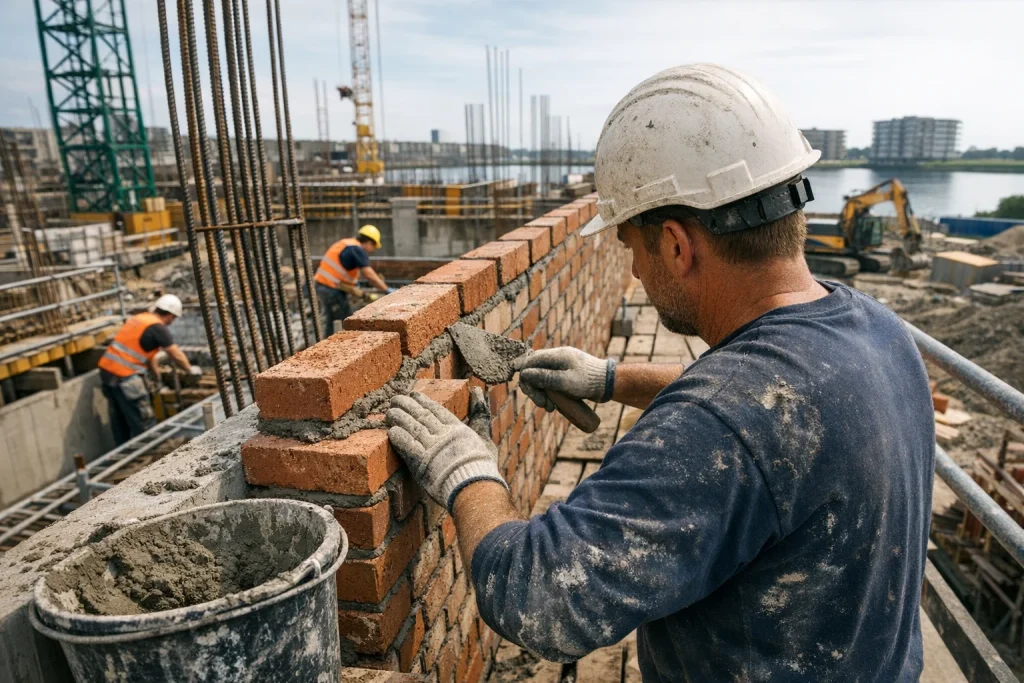
A construction worker from Romania applies through Haldu Groep for a carpenter position in Almere. As an EU citizen, no work permit is needed. They prepare a CV highlighting carpentry experience and VCA certification. After a successful interview, they receive a contract under the CAO Bouw & Infra with competitive pay and clear working hours. Haldu Groep arranges housing in a shared apartment with a private bedroom near the construction site. The worker attends a safety briefing, receives personal protective equipment, and starts work on a commercial building project. They commute easily by bike or public transport and have access to apprenticeship programs to improve skills.
| Role | Typical Experience Level | Certification Required | Housing Provided? | Language Requirement |
|---|---|---|---|---|
| Bricklayer | Skilled | VCA | Often yes | Basic Dutch or English |
| Laborer | Entry to Skilled | VCA | Sometimes | Basic Dutch or English |
| Electrician | Skilled | VCA, NEN 3140 | Depends | Basic Dutch recommended |
| Site Supervisor | Experienced | VCA, management training | Rarely | Good Dutch or English |
| Worker Origin | Work Permit Needed? | Housing Arrangement | Typical Pay Level |
|---|---|---|---|
| EU/EEA/Swiss | No | Agency or employer provided | Depends on experience / CAO |
| Non-EU | Yes | Often agency arranged | Depends on experience / CAO |
| Certification | Description | Importance | Where to Obtain |
|---|---|---|---|
| VCA | Safety certification for construction workers | Mandatory on most sites | Certified training centers in the Netherlands |
| STEIGER-certificaat | Scaffolding safety certificate | Required for scaffold work | Specialized training providers |
| NEN 3140 | Electrical safety standard | Essential for electricians | Technical schools or training centers |
| EHBO | First aid certification | Recommended for all workers | Red Cross or certified trainers |
Frequently asked questions
Do I need a work permit to work in Almere construction?
What construction jobs are in demand in Almere?
Is VCA certification mandatory?
How much can I expect to earn?
Will my employer provide housing?
What language skills do I need?
Are apprenticeships available for foreign workers?
What are typical working hours?
What personal protective equipment is required?
How do I prepare my CV for construction jobs in Almere?
Conclusion
Foreign workers aiming for construction jobs in Almere should first confirm their legal work status and obtain necessary safety certifications like VCA. Preparing a clear CV and applying through trusted agencies or companies improves chances of employment. Housing is often arranged by employers or agencies, easing relocation. Almere’s diverse construction projects and strong transport infrastructure support stable employment and career growth. Understanding contract terms, labor laws, and safety requirements is essential for success. Learning basic Dutch or English enhances communication and safety on site. With proper preparation, foreign workers can build rewarding careers in Almere’s construction sector.
