
Direct answer
Construction jobs in Apeldoorn are open to foreign workers, with EU/EEA/Swiss nationals able to work without a permit, while non-EU citizens must secure a valid Dutch work permit before employment. The city’s construction sector includes roles such as laborers, bricklayers, carpenters, electricians, and supervisors. Pay is competitive within the Dutch market and regulated by the CAO Bouw & Infra collective labor agreement. Safety certifications like VCA are often required, and basic Dutch or English language skills are important for site communication. Housing is frequently arranged by employers or agencies, usually offering private bedrooms near worksites. Apeldoorn’s construction projects cover residential, commercial, and infrastructure works, supported by good public transport and manageable commuting distances.
Key points
- EU/EEA/Swiss nationals can work in Apeldoorn construction without a permit; non-EU workers must obtain one.
- Common roles include laborer, bricklayer, carpenter, electrician, plumber, and site supervisor.
- Pay depends on role, experience, contract, and CAO agreements; generally competitive in the Dutch market.
- VCA safety certification is often mandatory or strongly recommended for site access.
- Basic Dutch or English language skills improve safety and communication on site.
- Housing is frequently arranged by employers or agencies, typically with private bedrooms near worksites.
- Working hours usually follow Dutch labor laws and CAO Bouw & Infra, often 40 hours per week.
- Apeldoorn offers good public transport and manageable commuting distances to construction sites.
- Personal protective equipment (PPE) such as hard hats, safety boots, and gloves is mandatory on sites.
- Haldu Groep supports foreign workers with job placement, permits, and housing in Apeldoorn.
- Understanding Dutch labor laws and CAO agreements is essential for fair pay and working conditions.
- Safety briefings and compliance with site rules are required for all workers.
Field expertise
Since 1999, Haldu Groep has specialized in placing foreign workers in Dutch construction jobs, including in Apeldoorn. The organization is well-versed in Dutch labor laws, CAO Bouw & Infra agreements, and safety standards such as VCA certification. Construction work in Apeldoorn spans masonry, carpentry, electrical installation, plumbing, and machine operation. Dutch labor law and CAO agreements regulate wages, working hours, and conditions to ensure fair treatment. Safety certifications like VCA are critical for compliance and employability. Haldu Groep’s experience helps foreign workers navigate permits, certifications, housing, and integration into the local labor market.
What should you know about construction jobs in Apeldoorn: guide for foreign workers?
Foreign workers should know that Apeldoorn’s construction sector is diverse, with projects in residential housing, commercial buildings, and infrastructure upgrades. EU/EEA/Swiss nationals can work freely, but non-EU workers must obtain work permits. Employers often require VCA certification to meet safety standards. Language skills in Dutch or English are important for understanding instructions and safety briefings. Housing is usually arranged by employers or agencies, often providing private bedrooms in shared accommodations near worksites. Apeldoorn’s location offers good public transport and relatively short commutes to construction sites. Pay and working conditions are regulated by Dutch labor law and CAO Bouw & Infra agreements.
How does construction jobs in Apeldoorn: guide for foreign workers work in practice?
Foreign workers typically apply through recruitment agencies or directly to construction companies. After verifying eligibility and permits, candidates submit CVs emphasizing relevant experience and certifications. Upon hiring, workers attend safety briefings and receive personal protective equipment (PPE). Daily tasks vary by role, from bricklaying and carpentry to electrical work or site supervision. Working hours usually follow a 40-hour week with possible overtime. Housing is often arranged near the worksite, reducing commute times. Communication on site is mainly in Dutch or English, and workers must comply with health and safety regulations. Employers provide training and support to ensure compliance with Dutch standards.
Which conditions apply for construction jobs in Apeldoorn: guide for foreign workers?
Conditions are governed by Dutch labor law and the CAO Bouw & Infra collective labor agreement. These regulate wages, working hours, rest periods, holiday entitlements, and safety standards. Pay scales vary by job type, experience, and contract but are generally favorable compared to many European countries. Safety is strictly enforced, with mandatory use of PPE and certifications like VCA. Non-EU workers must have valid work permits. Employers must provide safe working environments and comply with health regulations. Housing conditions depend on the employer or agency but usually meet Dutch standards, with private bedrooms common. Employment contracts specify all terms and must be provided in writing.
Which mistakes are common around construction jobs in Apeldoorn: guide for foreign workers?
Common mistakes include starting work without the proper work permit if non-EU, neglecting to obtain VCA certification, and lacking sufficient language skills for safety communication. Some workers fail to clarify housing arrangements before arrival, leading to difficulties. Others may misunderstand Dutch labor laws or CAO agreements, causing confusion about pay or working hours. An unclear or incomplete CV can reduce hiring chances. Ignoring PPE requirements or safety rules can result in accidents or dismissal. Not preparing for commuting logistics or failing to attend safety briefings are also frequent errors.
How do you proceed step by step?
- Check your eligibility: EU/EEA/Swiss workers do not need a permit; non-EU workers must obtain one.
- Prepare a CV highlighting construction experience, certifications, and language skills.
- Apply through agencies like Haldu Groep or directly to construction companies in Apeldoorn.
- Secure necessary certifications such as VCA and any trade-specific licenses.
- Confirm housing arrangements with your employer or agency before arrival.
- Attend safety briefings and receive PPE upon starting the job.
- Follow Dutch labor laws and CAO Bouw & Infra rules regarding hours and pay.
- Maintain communication in Dutch or English and adhere to site safety regulations.
What should you check before you start?
- Work permit validity if you are a non-EU worker.
- Whether your CV matches the job requirements and includes relevant certifications.
- Housing arrangements and costs, including location and amenities.
- Language requirements and whether you need to improve Dutch or English skills.
- Employment contract details: pay scale, working hours, and benefits.
- Safety certification requirements, especially VCA.
- Availability of personal protective equipment and site safety rules.
- Commuting options and travel time to the construction site.
What does this look like in practice?
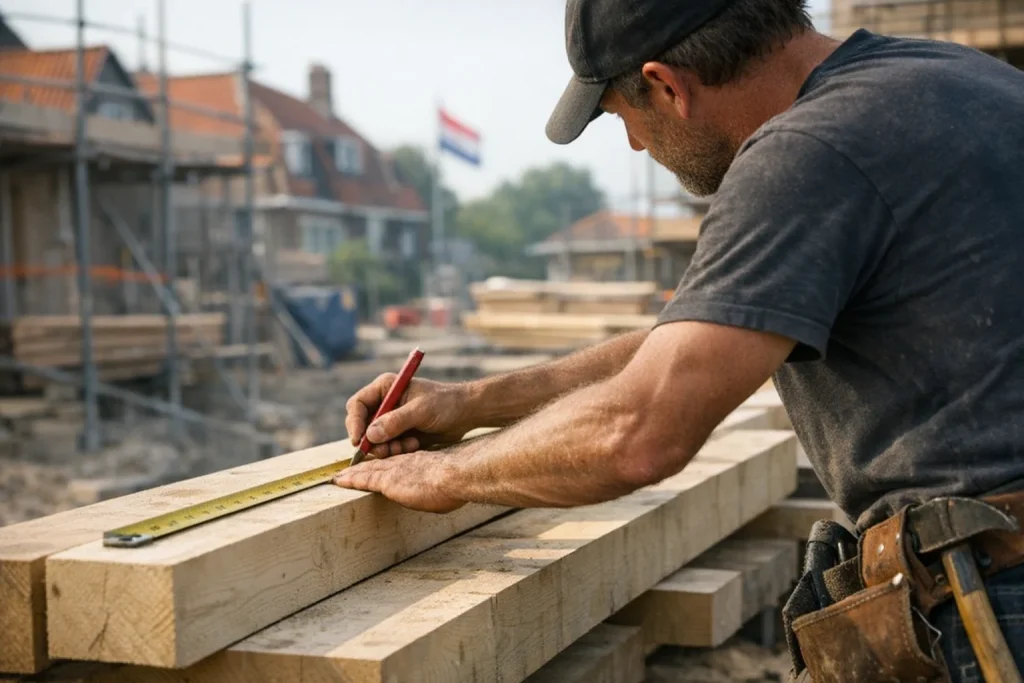
A foreign worker from Romania applies for a carpenter job in Apeldoorn through Haldu Groep. As an EU citizen, no work permit is required. The worker holds a VCA certificate and basic Dutch language skills. Haldu arranges a private room in shared housing near the construction site. On the first day, the worker attends a safety briefing, receives PPE including a hard hat and safety boots, and begins a 40-hour workweek. Pay is set according to CAO Bouw & Infra agreements. Daily tasks include measuring, cutting, and assembling wood structures. The worker uses local buses for commuting and communicates in Dutch with colleagues and supervisors.
| Role | Typical Tasks | Required Certification | Language Level | Housing Arrangement |
|---|---|---|---|---|
| Bricklayer | Laying bricks, reading blueprints | VCA mandatory | Basic Dutch or English | Usually provided by agency/employer |
| Carpenter | Woodwork, assembly, site measurements | VCA mandatory | Basic Dutch or English | Usually provided by agency/employer |
| Electrician | Wiring, installation, safety checks | VCA and trade license | Basic Dutch or English | Varies by employer |
| Site Supervisor | Overseeing work, safety compliance | VCA and management experience | Good Dutch or English | Depends on employer |
| Worker Type | Work Permit Needed? | Typical Pay Range | Housing Provided? | Language Requirement |
|---|---|---|---|---|
| EU/EEA/Swiss | No | Depends on experience / CAO | Often provided or arranged | Basic Dutch or English recommended |
| Non-EU | Yes, valid permit required | Depends on experience / CAO | Often provided or arranged | Basic Dutch or English recommended |
| Step | Action | Details |
|---|---|---|
| 1 | Check eligibility | Confirm nationality and work permit requirements |
| 2 | Prepare CV | Include experience, certifications, language skills |
| 3 | Apply for jobs | Use agencies or direct company applications |
| 4 | Obtain certifications | VCA and trade licenses as needed |
| 5 | Arrange housing | Confirm with employer or agency |
| 6 | Start work | Attend safety briefing, receive PPE |
Frequently asked questions
Do I need a work permit to work in construction in Apeldoorn?
What types of construction jobs are available in Apeldoorn?
Is VCA certification mandatory for construction workers in Apeldoorn?
How much can I expect to earn in construction in Apeldoorn?
Will my employer provide housing?
What language skills do I need?
What are the typical working hours in Apeldoorn’s construction sector?
Are there any specific Dutch labor laws I should know?
What personal protective equipment is required?
How can I improve my chances of getting hired?
Conclusion
Foreign workers seeking construction jobs in Apeldoorn should first verify their work permit status and obtain necessary certifications like VCA. Improving Dutch or English language skills will enhance safety and communication on site. Housing is often arranged by employers or agencies, typically offering private rooms near worksites. Pay and working conditions follow Dutch labor laws and CAO Bouw & Infra agreements, providing competitive wages and regulated hours. Agencies such as Haldu Groep offer valuable support with job placement, permits, and accommodation. Careful preparation and adherence to safety and legal requirements will help foreign workers succeed in Apeldoorn’s active construction sector.
